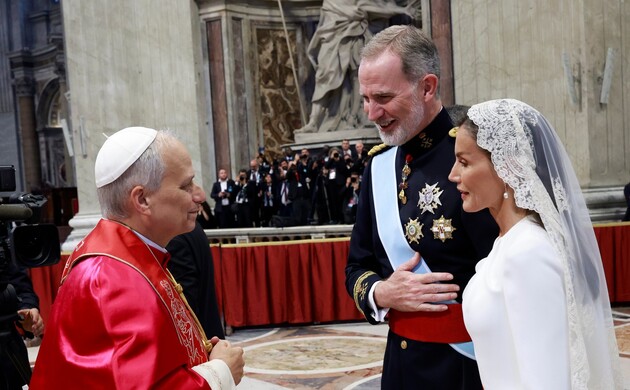
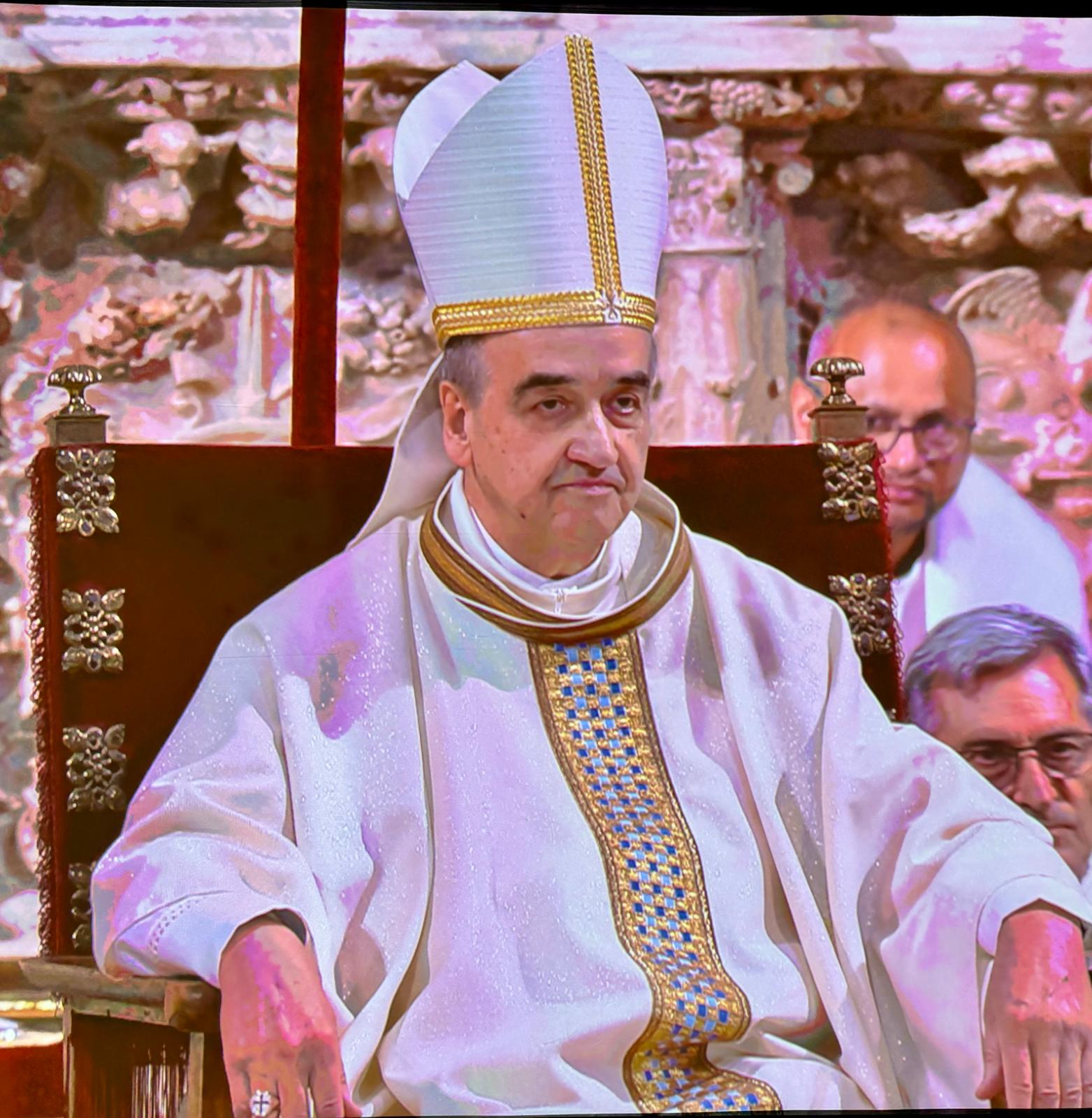
Bishop Pedro Aguado, former Superior General of the Piarist Order
IN THIS ARTICLE
- Two irreconcilable narratives expose a deep fracture between a victim and the Spanish Church
- Full video of both interviews broadcast on the Aragón TV programme Aquí y Ahora
- Full transcript of both interviews: first the victim, then Pedro Aguado, interviewed separately live on air
Enjoy the reading.
Jacques Pintor Team
Two irreconcilable narratives expose a deep fracture between a victim and the Spanish Church
What we present in this article is material that, once heard carefully, reveals a reality that cannot be softened without distorting it. The victim speaks first. Bishop Pedro Aguado speaks afterwards, without having heard any of the previous testimony. There is no adjustment of language, no opportunity to tailor a response to the accusations already made. What emerges is what each man says when he believes he is presenting his full account. And in that direct collision, uncontaminated by reaction or preparation, what appears is not a minor discrepancy but a frontal incompatibility.
The victim speaks of years of sexual abuse, of a life broken from childhood onward, of a youth marked by personal destruction, of a long process of collapse that cannot be repaired through institutional phrasing or carefully measured statements. He names a specific aggressor, a Mexican Piarist priest, and points to concrete decisions and concrete individuals who, according to his account, failed to act when action was still possible. He also points directly at the environment in which the abuse was not stopped by Pedro Aguado, now elevated to the episcopacy by the Vatican, when, according to the victim, it could have been stopped.
Aguado then takes the floor and presents his own version with a confidence that is clearly not improvised, but also not influenced by anything the victim has just said. He insists that he acted from the very beginning, that he informed the victim of his rights, initiated the canonical procedure, secured a rapid resolution and imposed what he describes as the gravest possible sanction. He stresses that the aggressor was expelled and reduced to the lay state, that he ceased to be a priest, and that the Church did what it was supposed to do within its own jurisdiction. And at the most sensitive point of all, he maintains that the victim did not wish to pursue criminal proceedings and that he respected that decision.
That is the moment when the narrative ceases to hold together. Because the victim says exactly the opposite. This is not a blurred memory or a disagreement over interpretation. These are two incompatible claims that cannot coexist unless one of them collapses at the core. Whether there was or was not a desire to report the abuse to the civil authorities is not a secondary detail. It is the axis around which responsibility turns. If there was a willingness to report and no action followed, the omission becomes obvious. And if there was no such willingness, then another and even more uncomfortable question arises: what happens when the gravity of the facts moves beyond the private sphere of the victim and enters the public obligation to pursue an alleged crime — particularly in direct contradiction to the uncompromising reporting obligations established by Pope Francis in Vos Estis Lux Mundi?
Aguado’s defence rests heavily on the canonical process. He repeatedly speaks of speed, resolution and definitive sanctions. He presents the internal procedure as a sufficient response, as evidence that the proper steps were taken and that his conscience is therefore clear. But that line of defence collapses the moment one introduces the element absent from his account: the lack of any criminal trial. The alleged aggressor, by Aguado’s own admission, died without ever being judged by a civil court. There is no criminal conviction, no sentence and no public reckoning before the law. That is not interpretation. It is a fact.
The victim introduces another element that further destabilises Aguado’s narrative. He claims that the aggressor remained active, continued celebrating Mass and maintained contact with minors. Aguado replies that he had no knowledge of such events and that, had they occurred, they would have constituted gravely disobedient and invalid acts. But the issue is not the sacramental validity of a Mass celebrated by someone who had already been dismissed from the priesthood. The issue is whether a person in that situation was still able to continue operating without anyone stopping him. And if so, what failed to prevent it.
At that point, the institutional discourse loses its footing. Declaring that something lacks validity does not make it unreal. If it happened, it happened outside the rules but within an environment that failed to stop it. And if it did not happen, then the victim’s allegations demand more than denial or claims of ignorance. They require evidence, verifiable facts and something more substantial than institutional reassurance. According to the victim, such evidence exists: thirty-two photographs allegedly showing the aggressor acting publicly as a priest in multiple locations after the supposed prohibition; certification from the Mexican police stating that he never travelled to Spain at the time Aguado claims he sent him there. And more besides.
The picture darkens further when the issue of money and agreements enters the conversation. The victim speaks of financial payments delivered in a context of extreme vulnerability, of proposals aimed at resolving the matter outside the judicial system, of what he perceived as an attempt to settle the case quietly and out of public view. Aguado uses entirely different language. He speaks of meetings attended by lawyers and frames the process as an initiative linked to what he calls restorative justice requested by the victim himself. Both men appear to describe the same territory, but they are not describing the same reality.
The fact that Aguado had not heard the victim beforehand removes the possibility of a calibrated response crafted around prior accusations. What emerges instead is his unfiltered account — the narrative he sustains when he is not reacting defensively in real time. That gives his words a significance that extends beyond the interview itself. It reveals the internal logic through which he justifies his actions, the framework in which he places the institution and the case, and the manner in which he structures the relationship between both. More importantly still, it becomes a visual and narrative confirmation of the victim’s account, because Aguado repeats precisely the explanations and institutional justifications that the victim had already denounced moments earlier.
What ultimately emerges from this contrast is the exposure of a model of institutional behaviour. A model in which the internal canonical procedure is presented as a sufficient response, in which criminal accountability is subordinated, delayed or displaced, and in which the institution acts inwardly first and only outwardly if compelled to do so.
There is no room here for rhetorical ornament. No neutral vocabulary can wrap itself around these facts without emptying them of meaning. What remains is a victim who says he sought justice and never found it in the sphere that should have provided it, and an institutional authority who insists that he acted correctly and respected a wish that, according to the other side, never existed. Between those two narratives there is no space for reconciliation without evidence capable of tipping the balance.
The final question is neither comfortable nor avoidable. How is it possible that, with safeguarding protocols already in place, with knowledge of the allegations dating back to 2010 — after a Mexican priest reportedly informed Aguado of the abuses committed by his fellow Piarist — and with clear institutional capacity to act, such a case could end without a criminal process bringing legal closure? The key witness in this history, Father Baltazar, a priest allegedly sent by Aguado to the United States and who later left the Piarist order, was, according to the victim, ordered into silence by his bishop.
Yet Vos Estis Lux Mundi explicitly condemns any superior who orders subordinates to remain silent regarding sexual abuse allegations. Pope Francis is dead and buried. But what was written remains written, as Pontius Pilate once said.
The Aragón TV video
All credit to Aragón TV and the programme “Aquí y Ahora”.
The Transcript of the two interviews
PRESENTER – And we are now going to speak with Javier Alcántara. He is a victim of sexual abuse. He reported having been the victim of sexual abuse, including aggravated rape, for more than three years, from 2007 to 2010, by the Piarist religious José Miguel Flores, and he accuses Pedro Aguado — then superior of the order and now Bishop of Jaca and Huesca in Spain — of cover-up, gross negligence, abuse of power and coercion. To give some context, this programme spoke, when a new Vatican investigation into the Bishop of Jaca and Huesca, Pedro Aguado, became known, with the person responsible for communication for the Piarist Schools, speaking on behalf of Pedro Aguado’s bishopric. Today we listen to the victim. Javier, welcome. How are you?
JAVIER ALCÁNTARA – Hello, Miriam, good afternoon over there. Thank you very much for giving me this space, above all for giving us a voice, which, unfortunately, as victims we often do not manage to have. More than focusing on the victimising acts I suffered in my childhood, I would like to counter several points that I consider important and that, in my view, were not stated with seriousness or truth.
First of all, the Catholic Church has an established protocol called Vos Estis Lux Mundi. Mrs Isabel Llauger, who is responsible for communication for the Piarist Order, speaks without context, because when a report of sexual abuse or any vulnerability involving a minor is received, the first thing that a priest, a nun or a person in charge must do is provide medical, psychological, psychiatric and legal assistance. So when she says that they insisted very strongly that I report it, that is not true.
When I saw Pedro Aguado in Cancún in 2019, he told me he was going to take clear and forceful measures, that he believed me, but that in the end there would have to be an investigation so that this man, basically, could be condemned. He told me that if, at the end of that investigation, the aggressor, Father José Miguel Flores, was found guilty, the mechanism would then be activated so that he could be reported.
I told him that I was coming from years of regression. It was not only 2019. My childhood had been marked, my youth had been destroyed, and I was coming out of a very difficult process of drug use. At the end of the day, it was not as if I was one hundred per cent strong enough to go and file a complaint with the prosecutor’s office in the way I am today.
Then the Vatican sentence came out — I am trying to summarise this as quickly as I can. Pedro Aguado showed it to me, and that is when I asked him for the second time: so, what is going to happen? Because supposedly José Miguel had already been subject to precautionary measures, which is false, because just last week the records from Mexico’s National Migration Institute came out, showing that Father José Miguel Flores entered Mexico in 2019 and never left the country again. So there is an inconsistency there, because José Miguel was in Mexico the whole time.
When the supposed sentence came out — and I say “supposed” because they have not wanted to show it again, arguing that it is a Vatican document, although I believe that, as the victim, I have access to it and should have been given a copy — I was told that José Miguel had basically received the harshest penalty possible for a priest: dismissal from the clerical state and expulsion from the Piarist Order.
At that point, Pedro Aguado gave me money in cash. And because of my need — because I also worked for the Piarists and earned 2,800 pesos every fortnight, which would be about 100 or 110 euros — I saw the money and I saw the need, because I was already a family man and had to support my wife and my son.
So it seemed right to me at the time, because from the beginning I trusted Pedro Aguado’s word. When I questioned him again about what was happening and when the man was going to be handed over, he said no, that I should have peace in my heart. Those were always his words.
I have an email in my possession, sent by my mother, in which she writes: “Father Pedro, I have forgiven him” — speaking of José Miguel — “but this is where I feel so wounded, because it does not seem fair to me that he is walking around the world living with his mother.” So if we are talking about justice, there would be none here.
PRESENTER – Javier, I am going to interrupt you for a moment, because everything you are telling us is very important, but we do have to summarise, as you yourself said. So Pedro Aguado, superior of the order at that time, did listen to you; you told him everything that had happened. He said there had to be an investigation, something that, according to you, took place in the Vatican and found in your favour. From there, you were told that José Miguel Flores would be removed, but you say that he was not removed from the order, that he continued carrying out duties within the Church and that he was not handed over to the courts either. What has been done, and you have done it yourself, is to file that complaint. A judicial process has now been opened by the Mexican Prosecutor’s Office, in which Pedro Aguado is accused of cover-up, among other offences we have mentioned.
JAVIER A. – That is correct.
PRESENTER – You were telling us that money had been given to you and you were explaining your family situation. So, from that point onward, what steps have been taken? We recently reported on the Vatican investigation that had been opened, and that investigation begins because your mother addresses the Vatican to denounce this alleged cover-up by Pedro Aguado. I believe you have received a response, even a recent meeting.
JAVIER A. – Yes. Yesterday I had a meeting with Tutela Minorum, with Monsignor Luis Manuel Ali Herrera. As for the complaint you refer to, it had in fact already been made on 9 December. It was submitted to the Apostolic Nunciature in Mexico and stamped by the Nunciature. In it, the Primate Cardinal of Mexico, Carlos Aguiar Retes, raised the complaint for serious violations of Vos Estis Lux Mundi after having opened a preliminary investigation.
Something that strikes me very strongly is that the Primate Archdiocese of Mexico was only informed on 14 August 2025 that Miguel had been removed. In other words, they were only told then that Miguel had ceased to be a priest — four years later.
What I wanted to get to is this: my mother asks whether this individual can be criminally prosecuted. That is clear proof that, from the beginning, we agreed that he should be reported. It is not true, as Mrs Isabel says, that they insisted that I report it. That is completely false.
They also speak of a pastoral error. But this involved the senior leadership: Father Sergio Fernando Hernández Avilés, who has also been reported, and Father José Luis Sánchez Macías, who was the one who paid me my scholarship month by month.
Something must be made clear: as a result of the complaint, they cancelled my university scholarship and cut off that part of my life too, because I have not been able to finish university with a scholarship for which I paid the difference.
In the meeting held yesterday, I was told that next week I will receive in writing the decision and the current state of the investigation opened on 9 December, which was raised by the Cardinal of Mexico and activated only on 27 March with Pope Leo.
I am perfectly willing to make it public. I have no problem with that. I only want them to stop lying. And most importantly, I want justice to be done, because Pedro Aguado is also named in the investigation file for the offences of human trafficking and criminal association.
And it is also very important that the account of Father Baltazar Sánchez Alonso be sought, or at least that an attempt be made to obtain it. Since 2010 he had warned that José Miguel Flores Martínez was a paedophile, and Pedro Aguado decided to send him to the United States and to send my aggressor to Spain and then to Ecuador. That is completely true.
PRESENTER – So, Javier, he was not removed, as you had been told. He was not removed. He continued, we confirm and underline, to carry out duties within the Church. We are also seeing images that would corroborate this. He was not brought before the courts and he died. Therefore, there can no longer be criminal consequences for José Miguel Flores. Now, through this new Vatican investigation, together with the open judicial process in Mexico, three people are accused of this offence of cover-up, one of them Pedro Aguado. That is where things stand. And regarding this latest meeting with the Vatican, you said you had the content of a letter, which we may or may not be able to know, from that conversation…
JAVIER A. – No. In fact, that was only raised yesterday, 4 May. The letter or official response from the Vatican will not arrive until next week. For now, that is all: it is under investigation.
It is also important to say that they claim that, at most, he celebrated one Mass. That is false. There are 32 photographs from different dates showing José Miguel in the chapel of the Morelos school, which belongs to the Piarists. In Tazcala, in the Basilica of Ocotlán, he also celebrated Masses, and at his brother’s school too. And of course, at his brother’s school he also had access to children and young people. From the beginning, when I sent my video to Pedro Aguado, that was what I asked: that he be kept away from children and young people, because in the end he was a predator.
I also sent an email on 22 January to Mrs Isabel Llauger asking her, and demanding, that she know my story and not revictimise me. I have received no answer. I do not know whether that can be made public; I have no problem with it. But, as I was saying, I only want justice to be done. And part of that justice is that those responsible pay and admit their errors, because that is part of restorative justice: recognising the harm done, not simply saying, “Well, yes, but if it happened, it only happened once.” That is a lie.
And I want the order to stop revictimising me, because they have also approached me and offered me money to reach an agreement quietly, under the table, an “amicable settlement”, and I do not think that is right.
I had an in-person meeting with Father Julio Alberto Álvarez Díaz on 23 March this year, in which they demanded that I tell them an amount, because, at the end of the day, they say they want to make reparation for the harm. I told them no. My legal team informed them that I only want to do this through the prosecutor’s office and, if applicable, through restorative justice — but through the prosecutor’s office, nothing in the dark.
And something very particular that I found out only last week is that the lawyers for the Piarist School — well, they identify themselves as lawyers for the Piarist School and for Pedro Aguado — have gone to the prosecutor’s office to put pressure on them to close the investigation. Unfortunately, the investigation file is so poorly put together that they are arguing that since it concerns rape, and since the aggressor has died, the case should be closed, that there should be nothing more.
This week I filed an appeal to try to ensure that a summons is sent to Spain, to Huesca, and to New York, where Father Baltazar is, and that they do not silence him. There is also a recording which I can send you, in which Father Baltazar says that he will no longer speak about the matter and that his bishop has ordered him to remain silent. So I think that is not unimportant.
PRESENTER – Javier Alcántara, your account of the facts has been clear. We hope that you are well now, psychologically well, and that justice is done. Thank you for joining us today on Aquí y Ahora.
JAVIER A. – And I am also grateful. If it is necessary for me to say this to Pedro Aguado’s face, I have no problem doing so. I leave that space, that possibility, open. And thank you very much for everything.
PRESENTER – Thank you, Javier. Well, we have heard the words of Javier Alcántara, victim of sexual abuse, and we are now going to speak with Pedro Aguado, Bishop of Jaca and Huesca, who is already listening to us. Hello. Good morning.
PEDRO AGUADO – Hello, good morning. Can you hear me?
PRESENTER – Yes, yes, we can hear you well. Good morning. I believe you were not able to listen — and that is a pity — to the interview we have just conducted with Javier Alcántara, victim of sexual abuse. We recall that he has been denouncing you; in fact, there is an open judicial process in Mexico and also an investigation in the Vatican. He accuses you of cover-up, gross negligence, abuse of power and coercion when you were superior of the Piarist Order, for not having taken all the measures in your power to bring José Miguel Flores, the man accused of sexually abusing this victim, to justice.
PEDRO AGUADO – Yes. Well, I am aware of these views expressed by Javier, whom I know well and respect very much. Certainly, when I first learned of the sexual abuse in 2019, I quickly went to speak with him. I listened to him, saw the seriousness of the matter and intervened.
I intervened in two directions. First, I clearly explained to him that he had the right to bring a civil complaint against his aggressor. He did not want to do so and insisted that it was not in his interest. I explained to him that I had the obligation to file a canonical complaint. I explained what that consisted of, and we did so through a complaint that was resolved quite quickly. In about ten months, it was resolved with the expulsion of the aggressor from the order and from the priesthood.
That decision, endorsed by the Holy See, was published in the official magazine of the Order, which is available on the website. It is a canonical decision, the gravest and most serious decision that can be taken: the expulsion from the order and from the priesthood of this young man’s aggressor.
PRESENTER – What the victim says, what Javier Alcántara says, is that he was not expelled. He shows images and says that he knows José Miguel Flores was not expelled, but continued within the Church carrying out certain duties, that he was not removed, and that this continued until he died. He also says that he did insist on the civil route being followed and that he found no support from you there.
PEDRO AGUADO – Well, I do not think that is correct. Father Flores was expelled and reduced to the lay state. He ceased to be a priest and a Piarist at the end of 2020. Neither I nor anyone else had any news that he, no longer being a priest — because he was not — was celebrating Eucharists or Masses until Javier himself told me after he had died.
That was when I went to Mexico and showed him the sentence signed by me and the Vatican sentence, and I translated for him what was in Italian and Latin so that he could know it properly. In other words, this man was absolutely expelled and completely reduced to the lay state, with no possibility of being a priest.
If he ever celebrated a Mass, that Mass is not valid and it is a deep and tremendous act of disobedience. Javier never asked me to report the aggressor civilly; on the contrary, he told me not to do so. Obviously, if he had asked me, I would have done so without any hesitation, as we have always done.
I always tried to respect his will. And I can certainly say that the canonical process against Miguel Flores, this young man’s aggressor, was properly conducted, clearly resolved and definitively settled.
That gives me peace of mind. It is true that this matter is always painful, always complicated, and everything can be improved. Certainly we all make mistakes. But there was no cover-up and no intention of covering anything up. Quite the opposite.
PRESENTER – When you say that he expressly asked you not to report it, not to file a complaint, do you believe that one should not report a person who repeatedly raped an eleven-year-old child over a period of years? Miguel Flores has died and has had no criminal conviction of any kind, nor was he even tried for it.
PEDRO AGUADO – That is true. What we did was to respect the victim’s will completely. If the same case arose today, without any doubt I would insist that it had to be reported, because we have also learned from that. Evidently, the victim’s will was one thing, and it was respected by the Piarists in Mexico. But without any doubt, if we had that situation today, that event, there would be no doubt that it would have to be reported. That is what must be done, without question.
This man died without being a priest and without being a religious, but it should have been reported. We respected that will completely.
PRESENTER – Right now there is an open investigation in the Vatican, which we recently learned about, alongside an open judicial process in Mexico against you. The victim has just told us that both you and the Piarist Schools, or you personally, have tried to reach an agreement with him — we do not know whether financial — so that he drops the matter. Is that the case?
PEDRO AGUADO – No, no, not at all. If he said that, it has been badly explained. Javier, quite reasonably, proposed that we talk in order to reach a proposal of restorative, reparative justice in his case. We replied that this seemed right to us, provided that we were in the presence of lawyers.
A first meeting was held, and then Javier closed that process and did not wish to continue. Recently he has proposed it again. I believe that, independently of a judicial process, it is good for both parties, at the request of the victim, to try to reach a comprehensive reparative solution for the abuse committed, because that will be good for him if he asks for it.
At this moment he has proposed it, and we are willing to move forward, provided that he asks for it. In order to do things properly and in order, I believe that what matters most is that this young man be fully restored in justice and in an integral way. There is no doubt about that. But there has been no initiative on our part. On the contrary, he is the one who proposed it, and we are the ones who said that if he wishes, of course we will talk.
PRESENTER – Pedro Aguado, Bishop of Jaca and Huesca, thank you for facing the issue and lending your voice to this interview on the programme Aquí y Ahora. Regards.
PEDRO AGUADO – Thank you very much as well. Thank you for the interview. I want to finish by saying that, on my part and on the part of the Order, there is no doubt about the priority of caring for victims. If there has been any mistake, of course we are willing to ask forgiveness. But what there always was, was the desire to help him, to listen to him and to accompany him, and that remains the case.
PRESENTER – Thank you again, and regards.
Readers are invited to comment, provide information, and participate in a factual and respectful debate.

If any factual statement contained in this article is considered inaccurate, readers may contact the editorial team to exercise their right of reply or request a clarification or factual correction, in accordance with journalistic standards.

The editorial team is also available to grant interviews; this applies—subject to appropriate protective safeguards—also to some of the individuals concerned.

© Jacques Pintor, 2018 - 2026. All rights reserved. Any reproduction or redistribution without prior authorisation is prohibited.

#CatholicChurch #ClericalAbuse #SexualAbuse #Accountability #Safeguarding #VosEstisLuxMundi #VictimsVoices #JusticeForVictims #ChurchReform #PedroAguado #PiaristOrder #Clericalism #InstitutionalSilence #AbuseCoverUp #Hypocrisy #MoralAuthority #PowerAndAbuse