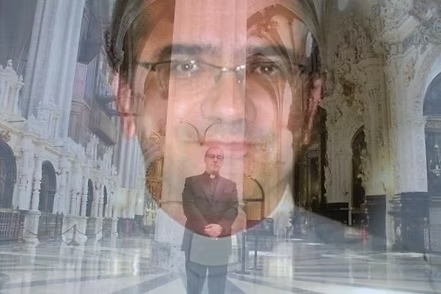
The Reverend Javier Pérez Mas, Director of the Office for Complaints and Prevention of Sexual Abuse of the Diocese of Aragon, Spain, and Rector of the Metropolitan Seminary of Aragón.
In 2021, a certified warning concerning the conduct of a newly ordained priest in Spain was formally submitted to the official abuse-prevention office serving the dioceses of Aragón. The correspondence, sent by a member of our investigative team, received no response.
The letter did not allege abuse, but raised documented concerns relevant to safeguarding obligations already in force under Spanish law. The absence of any institutional reply is now a matter of public record.
The journalist who reported these facts, Jordi Picazo (professionally known as all of us are, Jacques Pintor), is the only member of his investigative team based in Spain. He currently resides outside the country following sustained legal actions linked to his reporting on Church governance and accountability. In the absence of a final judicial ruling, his passport renewal has reportedly been denied and his assets frozen.
The combined proceedings seek financial penalties amounting to approximately half a million euros and custodial sentences totalling around four years. Whatever the outcome of those cases, the documented silence of an abuse-prevention office in the face of a certified warning raises broader questions about institutional responsibility and the conditions under which investigative journalism can operate freely.
(Full documentation and certified correspondence are available and will be posted following these entries shortly.)
Editorial Note
Within the context of this analysis, we highlight a documented fact that speaks for itself.
On 8 February 2024, public attention was drawn to the direct appointment of the still priest Vicente López-Brea as Director of Health Management for the Calatayud health region, a position filled without public competition. Political representatives in Aragón formally requested explanations. We have previously reported on this matter in a separate entry, which readers can consult via the link here.
This article does not focus on that appointment per se, but on something far more serious and structurally revealing:
a formally documented warning, sent in 2021, ignored by the very office tasked with preventing abuse. What follows is not opinion. It is a certified letter, its legal context, and the institutional silence that followed.
The Context
Before his ordination, Vicente Jesús López-Brea Urbán had been repeatedly observed engaging in sexual activity in public venues. During his three years of active priestly work, he neglected more than fifteen parishes in the Diocese of Huesca-Jaca while studying law and undertaking internships in Zaragoza, all while aspiring to a role within the Aragón public health system. This situation was reported in detail in a previous article, which can be consulted via the following link here.
The documentation exists.
The warnings were explicit.
Despite this, López-Brea was ordained by Bishop Julián Ruiz Martorell, allegedly in contradiction with Canon Law, and subsequently initiated legal action connected to the investigative reporting that brought these facts to light.
Jordi Picazo (Jacques Pintor), the only member of our investigative team based in Spain, currently lives in exile due to sustained judicial harassment linked to his reporting on Church corruption. In the absence of a final court ruling, his passport renewal has reportedly been denied and his assets frozen.
The combined legal actions seek financial penalties amounting to approximately half a million euros and criminal sentences totalling around four years of imprisonment, a scale that goes far beyond proportional civil redress and raises serious concerns regarding the instrumentalisation of judicial mechanisms to silence investigative journalism.
What matters here is not retaliation—but prevention.
Full Transcription of the Certified Letter
Madrid
Mr. Javier Pérez Más
Director
Office for the Reception of Reports and Complaints of Sexual Abuse
Dioceses of Aragón
Archdiocese of Zaragoza
Plaza de la Seo, 5
50001 Zaragoza
Dear Mr. Pérez Más,
Following my unanswered email sent on 17 September 2021 to your office and to the Bishop of Huesca-Jaca, I am now writing again to formally send you that same letter by certified mail, accompanied by this cover note and additional documentation.
Re-reading the mission entrusted to the institution you serve—namely, the care of victims of sexual abuse by clergy and citizens where applicable, and the prevention of such abuse—I cannot avoid recalling the words of Pope Francis, as published in The Strength of Vocation (Claretian Publications, 3 December 2018):
“The question of homosexuality is a very serious issue that must be properly discerned from the beginning with candidates, if that is the case. We must be demanding. In our societies, it even seems that homosexuality is fashionable, and that mentality, in some way, also influences the life of the Church.”
These words were reported by PeriodistaDigital.com on 27 November 2018, in advance excerpts from the book The Strength of Vocation: Consecrated Life Today, a conversation between Pope Francis and Fr. Fernando Prado.
The Pope states clearly:
“The ministry or consecrated life is not the place for them.”
He further explains that when candidates present strong psychological imbalances or unresolved issues, they must not be admitted to the priesthood, for the sake of the faithful they are meant to serve.
Despite the gravity of this matter, no response was received from your office.
This silence is particularly difficult to understand in light of the renewed global awareness of clerical abuse, following the devastating report on decades of abuse in the French Church. Even the President of the Pablo VI Foundation publicly acknowledged that report as a necessary step toward reform.
Failing to respond to documented evidence regarding the sexual conduct of a newly ordained priest—conduct allegedly known to his bishop prior to ordination—empties institutional promises of credibility.
A Direct Legal Question
I therefore reiterate and formally extend to you the question previously addressed to the Bishop of Jaca:
Did D. XYZ present the legally required negative certificate for sexual offences before being assigned to work with minors in the Diocese of Huesca-Jaca?
I ask this as a journalist. You may reply either by email or by post.
Applicable Law
Since 25 June 2021, Organic Law 8/2021 on the Comprehensive Protection of Children and Adolescents against Violence is in force in Spain.
Key provisions include:
- Any professional in contact with minors must not have been convicted of sexual offences and must prove it.
- The statute of limitations for victims begins at age 35.
- Penalties for sexual offences against minors are aggravated.
- Article 14 imposes a duty to report any indication or suspicion of violence against minors.
Failure to act upon known risks may itself constitute a violation of the law.
Institutional Silence and Responsibility
If no adequate response were to be received, I would be legally compelled—under civil and canon law—to formalise a complaint, to avoid personal liability for withholding knowledge of a serious risk.
This is not ideological.
It is compliance.
It is prevention.
It is the common good.
Yours sincerely,
Jacques Pintor
Investigative journalist
Madrid, 7 October 2021
Feast of Our Lady of the Rosary
Attached Documentation
- BOE publication of Organic Law 8/2021
- PeriodistaDigital article citing Pope Francis (27 Nov 2018)
- Press coverage on the removal of Archbishop Manuel Ureña
- Screenshot of unanswered diocesan web submission
- Certified letters, testimonies, WhatsApp conversations, videos, and official records corroborating the facts described
(All documents were submitted with the original certified mailing and will be posted following these entries shortly.)
Why This Matters
Abuse prevention does not begin with victims.
It begins when warnings are received.
Silence, in such cases, is not neutral.
It is structural.
Legal clarification: All figures, procedural descriptions, and legal consequences mentioned herein refer to aggregated claims and reported procedural measures; they do not constitute a judicial finding of guilt and remain subject to ongoing legal proceedings.
#InvestigativeJournalism #PressFreedom #Safeguarding #AbusePrevention #BishopJulianRuizMartorell
© Jacques Pintor, 2026. Todos los derechos reservados. Este contenido forma parte de una investigación periodística independiente. Para comunicaciones, aclaraciones, entrevistas o el ejercicio del derecho de réplica:
jacquespintor@gmail.com Síguenos en X / Twitter: @jacquesplease