Isabel Llauger
IN THIS ARTICLE
- Does corporate communication serve the truth or the institution?
- The victim’s request for transparency and accountability
Enjoy the reading. Jacques Pintor Team
Does Corporate Communication Serve the Truth or the Institution?
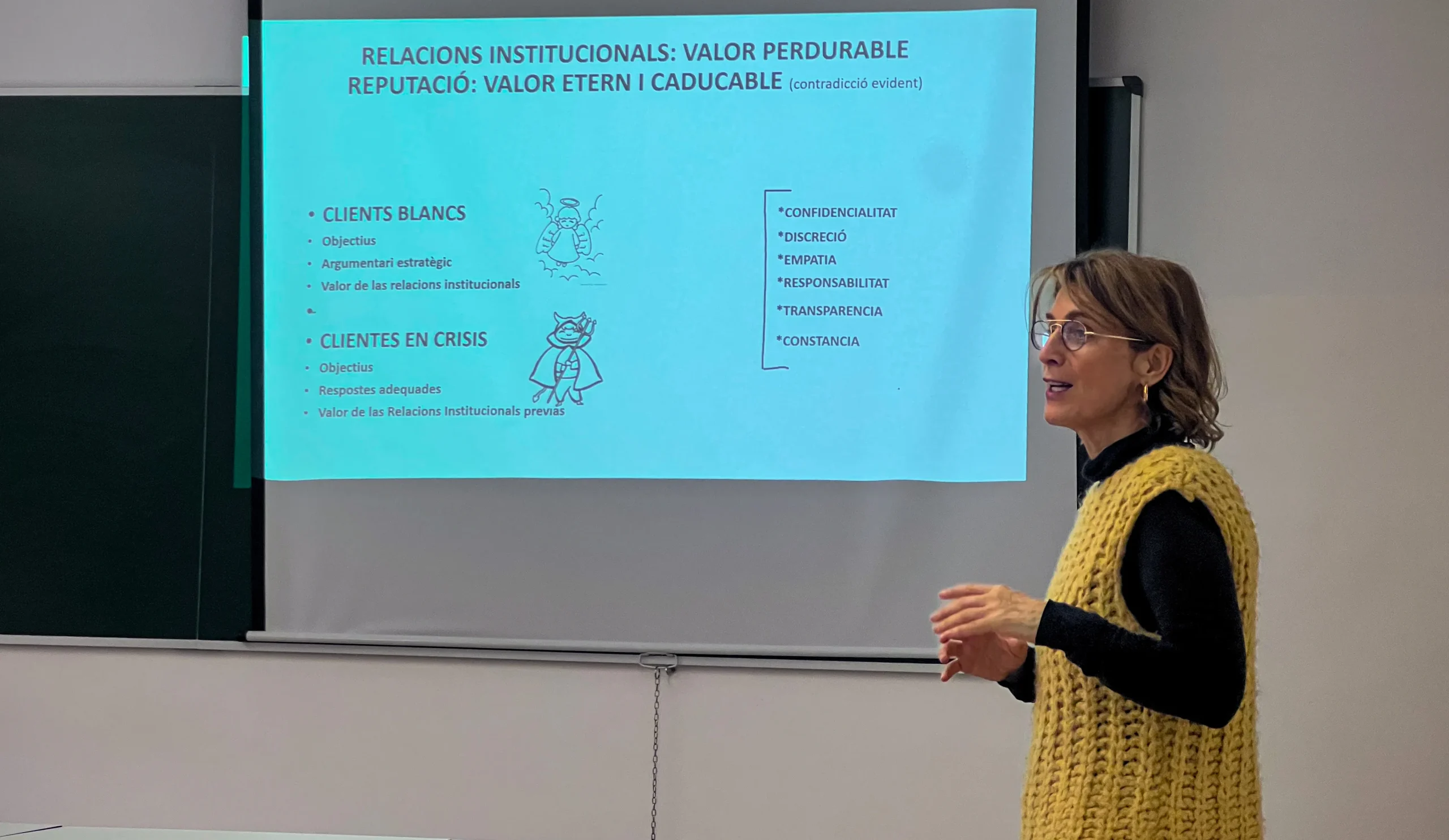
In the case of Javier Alcántara, a victim of sexual abuse at the hands of a Piarist priest in Mexico between the ages of eight and eleven, who is now denouncing years of concealment by the Order — as we have previously pointed out here — Isabel Llauger’s television intervention on Aragón TV’s programme Aquí y Ahora becomes especially significant not only because of what it explicitly states, but because of the entire discursive architecture it deploys when analysed through the lenses of narrative coherence, institutional credibility and crisis communication. The complete preservation of hesitations, reformulations, repetitions and spontaneous corrections makes it possible to observe with precision how a highly monitored narrative is constructed in real time, particularly at those moments where legally sensitive concepts such as investigation, civil authority, concealment or institutional responsibility arise.
From the very beginning of the interview, it becomes clear that the primary objective of the intervention is not so much to clarify concrete facts as to reframe the moral and legal meaning of certain decisions taken by the Order. The argumentative structure remains constant: to minimise direct institutional responsibility, reinforce Pedro Aguado’s image of diligence, shift part of the causal burden onto external elements and transform any possible error not into a grave omission, but into a consequence allegedly derived from empathy towards the victim. Shame. That rhetorical operation reaches its highest expression when Isabel Llauger states that the decision not to take the case to the civil authorities responded to Javier Alcántara’s explicit wishes and to the desire not to revictimise him. The wording is carefully constructed to transform a possible institutional omission into a decision presented as humane and compassionate.
However, it is precisely there that one of the main problems of the discourse’s internal credibility emerges. The interview attempts to sustain simultaneously two theses whose coexistence becomes extremely difficult from a logical standpoint: on the one hand, that Pedro Aguado acted “with total diligence”; on the other, that the matter was never brought before the civil courts despite involving extremely serious allegations concerning minors. The tension between those two ideas runs throughout the entire intervention and is never truly resolved. Each time the journalist insists on that problematic core, the discourse shifts towards emotional, contextual or terminological explanations, avoiding direct confrontation with the central contradiction.
At this point, the almost obsessive insistence on legally delimiting the Order’s responsibility regarding José Miguel Flores’ later actions becomes especially significant. Expressions such as “outside the structure’s control”, “he was not authorised”, “outside the institutional universe” or “without the knowledge of the general curia” appear repeatedly. From a technical perspective, this constitutes a classic strategy of reputational containment aimed at constructing institutional distance. Yet precisely because of its repetition, it produces the opposite effect in perceptual terms: the more insistently the structural connection is denied, the more evident it becomes to the viewer that the protection of the institution’s perimeter of responsibility constitutes the true gravitational centre of the discourse. Vergogna.
A particularly significant rhetorical element also emerges here: the continuous accumulation of preventive explanations and anticipatory justifications. In classical terms, the logic of excusatio non petita, accusatio manifesta — an unasked-for excuse, a manifest accusation — becomes strikingly apparent. The intervention contains a constant succession of qualifications, reformulations and excuses aimed at neutralising possible inferences on the part of the viewer before those inferences have even fully formed. That permanent need to reinterpret the meaning of every decision, every omission and every action ultimately conveys the impression of a defensive discourse more concerned with controlling interpretative consequences than with offering a transparent and linear reconstruction of the facts.
Especially revealing is the treatment of the word “investigation”. When the presenter underlines that the Vatican does not routinely open investigations of this nature, Isabel Llauger responds by semantically shifting the concept itself. At first she appears to relativise the existence of a significant investigation; afterwards, she redefines the “real investigation” as the one initiated years earlier when Pedro Aguado supposedly passed information on to the Vatican. The manoeuvre does not openly deny the problem, but rather alters the conceptual framework within which it must be interpreted. Technically, the argument may attempt to sustain itself; communicatively, however, it generates the perception of rhetorical evasion.
Another particularly important aspect is the recurrent use of emotional and therapeutic vocabulary: “comfort”, “personal reconstruction”, “empathy”, “solidarity”, “not revictimising”. That lexicon serves a very precise function within contemporary institutional communication: to humanise the organisation’s position and shift the focus away from structural responsibility towards emotional accompaniment. The problem arises when that layer of affective language coexists simultaneously with a constant effort to legally limit any institutional responsibility whatsoever. The combination of both registers produces a certain perceptual artificiality: the viewer witnesses at the same time the will to appear compassionate and the permanent need to shield the institution. Lost shame. Institutional disgrace.
From the perspective of discursive nervousness analysis, various micro-indicators of communicative tension also emerge. When the presenter opens the interview by saying “Welcome”, Isabel Llauger automatically replies “Welcome, and thank you for contacting us.” The repetition reflects a cognitively accelerated and insufficiently grounded conversational entry. It does not prove falsehood, nor does it constitute autonomous evidence of anything, but it does fit into a broader pattern of intervention subjected to a high degree of reputational control. The same applies to the repetitions, abandoned sentences, hesitations, immediate reformulations and agreement errors that appear precisely in those segments dealing with the most delicate issues.
Within that context, the abrupt ending of the interview also acquires special significance. Isabel Llauger interrupts the conversation claiming that she must immediately attend another meeting and that “they are waiting for her”. Humanly speaking, this may be a perfectly legitimate explanation. However, from the standpoint of institutional communication, the detail becomes striking because it occurs precisely at the moment when the journalist was entering the most sensitive core of the case: the exact nature of the investigation and the possible institutional responsibility involved. Given that she is a professional spokesperson accustomed to public appearances and linked to corporate communication and compliance environments, it is reasonable to think that a television intervention concerning a matter of such gravity would normally have been scheduled with sufficient time margin. The final perceptual effect is therefore one of growing discursive discomfort and an increasing need to leave the media spotlight before certain contradictions could be explored more deeply.
The probably most revealing sentence of the entire intervention comes at the end, when Isabel Llauger admits that, “with today’s eyes”, they would probably not act in the same way. That statement introduces a very significant internal fracture within the institutional narrative itself. No grave negligence or deliberate concealment is explicitly acknowledged, but there is nonetheless an implicit admission that what was considered correct at the time would today be reconsidered. From a forensic discourse-analysis perspective, that partial admission is enormously significant because it retrospectively weakens the initial thesis of complete diligence. O tempora, o mores — what times, what customs. Or, put without Latin: shame.
The strongest element of our analysis remains the one identified above: the communicative asymmetry. While the victim’s formal request for a right of reply, addressed to Isabel Llauger and reproduced below, remained unanswered for months, the institutional spokesperson was participating extensively in a television programme publicly reinforcing a unilateral narrative concerning the very same events. It was for this reason that Javier Alcántara personally contacted the programme’s brilliant presenter requesting that right, which was ultimately granted to him in an extraordinarily graphic manner (see here — includes video of the interviews and full transcripts).
Request for Transparency and Accountability – January 2026
Dear Mrs Llauger Ribas,
I am writing to you in my capacity as a victim and in your role as spokesperson and reputation manager for the Pious Schools and for Mr Pedro Aguado.
I am writing to formally express my absolute bewilderment and profound distress regarding the public statements recently issued — statements which not only lack coherence, but are also inappropriate and offensive to someone who directly suffered the events in question.
First of all, it is unacceptable for public statements to be made about me when you do not know me, have not spoken to me and have not sought my version of events. I ask you to explain on what basis you consider it legitimate to make pronouncements about a specific case without first having listened to the victim.
Secondly, the assertion that “everything was done correctly” is incompatible with one essential fact that nobody has explained: José Miguel Flores Martínez was never placed at the disposal of the justice system. I have had access to the death certificate that was presented, and I must point out that it does not correspond to the person I knew and who harmed me. Far from closing the matter, this element aggravates it and demands clear explanations.
For all these reasons, I formally claim my right of reply and demand, with the firmness that the situation requires, that Mr Pedro Aguado answer one single question clearly, directly and without ambiguity:
if everything was done correctly, why was José Miguel Flores Martínez never handed over to justice?
This must be stated with complete clarity: the source of my pain, my indignation and this entire conflict is not a narrative or an interpretation, but the fact that a predator was consciously allowed to remain in charge of girls and boys, when the moral, ethical, civil and legal duty of any responsible institution was to remove him immediately and hand him over to justice — not to protect him, not to silence the facts and not to allow him continued access to minors.
That is the core of the harm, that is the irreparable fact. Everything else is public relations.
Public Nature of This Communication
I hereby inform you that, as a victim and directly affected party, and given that the events in question have already been the subject of public communications by the institution you represent, this communication and any response issued may be made public. My sole and exclusive purpose is to reach the truth, obtain clear explanations and contribute to the accountability that a democratic society requires, without any intent to defame and in the legitimate exercise of my right to transparency and reparation.
Javier Alcántara
Readers are invited to comment, provide information, and participate in a factual and respectful debate.

If any factual statement contained in this article is considered inaccurate, readers may contact the editorial team to exercise their right of reply or request a clarification or factual correction, in accordance with journalistic standards.

The editorial team is also available to grant interviews; this applies—subject to appropriate protective safeguards—also to some of the individuals concerned.

© Jacques Pintor, 2018 - 2026. All rights reserved. Any reproduction or redistribution without prior authorisation is prohibited.

#CatholicChurch #ClericalAbuse #SexualAbuse #Accountability #Safeguarding #VosEstisLuxMundi #VictimsVoices #JusticeForVictims #ChurchReform #PedroAguado #PiaristOrder #Clericalism #InstitutionalSilence #AbuseCoverUp #Hypocrisy #MoralAuthority #PowerAndAbuse