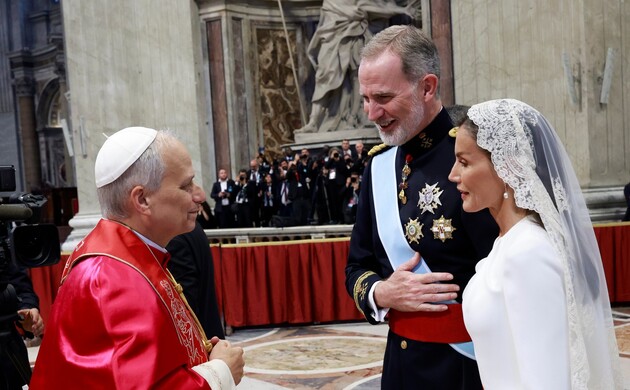
Leo XIV with the King and Queen of Spain
Pope Leo XIV has recently called on the bishops of Latin America to listen to victims of abuse and to assume personal responsibility for confronting this crisis. Yet every institutional exhortation is ultimately put to the test when a concrete case emerges that directly challenges the authority that issues it.
The inconsistency that challenges the Church
The letter from Claudia, a Mexican mother whose young son was repeatedly raped for years by a Piarist priest, directly challenges that exhortation by the Pope. Because this mother’s document is not merely another testimony. It is also a text that confronts the concrete application of pontifical norms in a specific case, faced with the deaf ears of the ecclesial community—first through the lack of charity toward victims, and second through the failure to comply with Pope Francis’s motu proprio Vos Estis Lux Mundi, in collaboration with the laws of civilized societies.
And here a tension emerges that today runs through the Catholic Church worldwide: the distance between the principles proclaimed and the “user experience” of those who seek justice within its structures.
A Church that proclaims a culture of care proves its credibility not when it speaks about victims, but when it answers the letters that victims write.
The contradiction between Leo XIV’s message and the silence surrounding Claudia’s letter
The message sent by Pope Leo XIV to the 2026 CEPROME Congress in Costa Rica clearly establishes the moral and pastoral framework from which the Church claims today to confront the crisis of sexual abuse. In that text, the Pope acknowledges that the problem constitutes one of the deepest wounds of contemporary Christianity and stresses that it cannot be treated as a technical matter reserved for specialists.
“It is not a specialized field reserved to a few experts, but an essential dimension of the Church’s evangelizing mission.”
(Papal message, paragraph 1)
The document strongly emphasizes the personal responsibility of those who govern the Church. It does not speak merely of rules or protocols, but of the direct responsibility of pastors.
“The leaders of the local Churches bear a particular and non-delegable responsibility in this process.”
(Papal message, paragraph 3)
It immediately adds that this responsibility cannot be limited to the application of formal procedures:
“They are called not only to ensure norms and procedures, but to assume personally a culture of care capable of preventing abuse and listening to victims…”
(Papal message, paragraph 3)
The most explicit passage of the message appears when the Pope refers to the duty to listen to those who report abuse within the Church:
“Listening to victims is not an optional gesture, but an act of justice and truth.”
(Papal message, paragraph 6)
The sentence is unequivocal. It is not presented as a pastoral recommendation or a spiritual ideal, but as a demand of justice.
For precisely that reason, however, the papal message also becomes a criterion from which the concrete cases that reach Rome may be examined. And one of those cases is the letter that a Mexican mother sent to the Pope on January 30, 2026, denouncing alleged institutional cover-up in a case of sexual abuse against her son when Pedro Aguado—now elevated to the episcopal order and appointed, in the midst of crisis, Bishop of Huesca-Jaca in Spain—was Superior General of the Order of the Piarist Fathers.
The contrast is unavoidable. While the Pope states that listening to victims constitutes an act of justice, the author of that letter maintains that her complaint—accompanied by documentation and sent directly to Rome—has received no response.
The contradiction is not merely rhetorical. For the papal message itself states that reparation within the Church requires more than words or protocols.
“Reparation… requires a clear ecclesial vision, founded on truth, the assumption of responsibilities, and persevering accompaniment over time.”
(Papal message, paragraph 6)
It is precisely at this point that the principles proclaimed in the pontifical message—written to be read at the CEPROME Congress held between March 2 and March 5, 2026 (Claudia’s letter was received by the Pope and stamped at the Vatican post office on February 13)—confront the concrete reality of the complaints that reach the institution. When a victim—or the mother of a victim—addresses a documented complaint to the highest authority of the Church, the principle of listening that the Pope himself defines as an “act of justice and truth” ceases to be a general declaration and becomes a concrete test of institutional coherence.
The letter that challenges Pope Leo XIV
On January 30, 2026, Claudia I. C. decided to write directly to Pope Leo XIV. She currently lives outside her country of origin. She is a mother. And she did not write a devotional letter or an abstract plea. She wrote a formal complaint. You may read it in the entry attached in this section.
Claudia began with a direct personal identification and a clear statement of the object of her complaint:
“I address you with respect. My name is Claudia… I am Mexican… and I write to you to denounce the current Bishop of Huesca and Jaca… Pedro Aguado Cuesta…”
(Letter, paragraph 2)
There is no anonymity or ambiguity. The author immediately defines the scope of her accusation, which includes alleged acts of cover-up, negligence, and abuse of power.
In the same opening paragraph, Claudia lists the central elements of her complaint:
“…for alleged acts of cover-up, favoring wrongdoing, serious negligence, abuse of power, coercion, and direct violations of the obligations established in ‘Vos Estis Lux Mundi’…”
(Letter, paragraph 2)
This beginning is important because it establishes from the outset the nature of the document: it is not an isolated emotional testimony but a complaint invoking a specific pontifical norm.
When institutional silence contradicts Francis’s Vos Estis Lux Mundi
The letter then presents the core of the case: the continuing sexual abuse suffered by her son, involving more than seventy rapes. Claudia describes the facts with a starkness that reflects the devastating impact she attributes to what happened:
“This sexual abuser raped my son for years… According to medical reports, he raped him between seventy and eighty times over several years…”
(Letter, paragraph 4)
The author also underlines the psychological consequences of those abuses:
“…abusing the authority of his cassock and manipulating my son until he had no will left, leaving him with terrible emotional and physical damage.”
(Letter, paragraph 4)
From her perspective, the case did not end with the denunciation of the aggressor. The center of her letter concerns the actions of ecclesiastical authorities. Claudia states that she personally reported the facts to the then Superior General of the Piarists:
“I personally reported the priest… and I denounced him before Pedro Aguado Cuesta in 2019… I traveled to Rome to the Piarist General House and there I spoke personally with Pedro Aguado…”
(Letter, paragraph 3)
This statement is the nodal point of the document. Because the issue then moves—Claudia indicates that she attaches emails and evidence—into the field of the institutional obligations established by Vos Estis Lux Mundi. Claudia herself maintains that those obligations were not fulfilled:
“Pedro Aguado should have reported the aggressor to the police and prosecutors as soon as the sentence removing him from the priesthood had been issued, and he did not do so.”
(Letter, paragraph 5)
The letter insists on the idea of a discretionary management of the case:
“Pedro Aguado has done everything in his own way, in his own style…”
(Letter, paragraph 6)
Such statements form the core of her institutional accusation.
The letter no one answers: the Aguado case before Leo XIV
The document also introduces an episode that the author describes as particularly painful for her family. After the canonical sanction that removed the aggressor from the clerical state, Claudia maintains that the public memory of the priest was handled in a way she perceives as an additional humiliation. She describes the Mass celebrated after his death as follows:
“…it is not possible that they attended to offer condolences and said he died as a Piarist priest when there was already a sentence stating that he had not been a priest for two years.”
(Letter, paragraph 7)
According to the letter, the ceremony included public praise of the priest:
“…they said such beautiful things, calling him a great priest, a great human being, a great friend…”
(Letter, paragraph 7)
The author interprets this episode as an example of the lack of empathy toward the victim. The emotional tone of the document appears explicitly in several passages, among them one of the most direct:
“José Miguel Flores Martínez killed us while we were still alive. He stole my son’s childhood, adolescence, and adulthood…”
(Letter, paragraph 4)
These sentences do not belong to legal language. They are the direct expression of a traumatic experience that runs throughout the entire letter.
The structural dimension of the problem
The letter concludes with a concrete request for institutional reparation. Claudia does not limit herself to denunciation. She formulates specific demands:
“I ask for full reparation of the damage, including all benefits for my son and medical, psychological, and psychiatric treatment…”
(Letter, paragraph 8)
She also requests disciplinary measures:
“…that the persons named in this letter receive exemplary punishment.”
(Letter, paragraph 8)
These demands transform the document into more than a personal account. They turn it into a dossier open to institutional examination. Because the central question raised by the letter is simple in its formulation, though complex in its implications:
if an ecclesiastical authority had knowledge of serious facts in 2019, were the obligations established by Vos Estis Lux Mundi activated or not?
The complete message of Pope Leo XIV to the 2026 CEPROME Congress
(Full papal message translated faithfully into English)
Dear brothers and sisters,
esteemed pastors of the Church pilgrim in Latin America,
representatives of CEPROME:
I welcome and greet the path you are undertaking together today, a path that touches one of the deepest and most painful wounds of the Body of Christ. This journey presents itself as an authentic sign of renewal and a concrete commitment to all victims and to the Church itself. It is not a specialized field reserved to a few experts, but an essential dimension of the Church’s evangelizing mission, one that challenges the conscience of every pastor and every ecclesial community.
This congress, held in San José, Costa Rica, in these first days of March, concretely expresses the commitment of the Church in this region. I extend special gratitude to the Episcopal Conference of Costa Rica, which participates actively in this meeting with representatives from its various dioceses, offering a valuable testimony of communion, shared responsibility, and pastoral closeness.
The path of reparation to which the Church is called cannot be reduced to a series of formal requirements. It demands instead a genuine conversion in justice: personal, pastoral, and institutional. The leaders of the local Churches bear a particular and non-delegable responsibility in this process. They are called not only to ensure norms and procedures, but to assume personally a culture of care capable of preventing abuse, listening to victims, and bearing witness to the tenderness of Christ, transforming wounds into openings of hope.
The lessons learned in recent years have clearly shown that wherever bishops and major superiors assume this commitment as an integral part of their ministry, the Church becomes more credible, more humane, and more evangelical. In this perspective, CEPROME is called not only to be a center of formation but also a place of ecclesial convergence, capable of accompanying the particular Churches in a continuous process of maturation.
The collaboration with CELAM and CLAR is therefore decisive. Only by uniting the pastoral responsibility of bishops, the charismatic richness of consecrated life, and interdisciplinary competencies will it be possible to build responses that are truly inculturated, sustainable, and oriented toward the integral good of persons.
This dialogue, however, cannot be only hierarchical, because authentic prevention arises from listening and understanding. Listening to victims is not an optional gesture but an act of justice and truth. From that listening emerge credible policies, integral processes of reparation, structures of responsibility, and mechanisms of accountability. Reparation in the Church cannot be separated either from mercy or from respect for the law, but it cannot be reduced to them alone. It requires a clear ecclesial vision founded on truth, the assumption of responsibilities, and persevering accompaniment over time.
This is a demanding path that requires the courage to take bold, brave, and consistent decisions. All this is necessary in order to care for our wounded brothers and sisters and to persevere in the shared commitment to protection and care.
For this reason, I am pleased to accompany this moment of work and communion that has brought you together to fulfill this mission. I entrust you to the Holy Spirit, that he may guide you in ever more fruitful collaboration. I encourage you to persevere without discouragement in the face of difficulties, remembering that every authentic step toward truth and reparation is already a sign of hope for the Church and for the world.
May Our Lady of the Angels accompany this path of care and renewal.
Fraternally,
Leo PP. XIV
If listening to victims is, as the Pope himself affirms, “an act of justice and truth,” then every letter that reaches Rome awaiting an answer becomes a test of credibility for the Church that proclaims that principle.
Readers may access the Spanish version of this article for additional links and photographs.
Readers are invited to comment, contribute information, and participate in a factual and respectful discussion.

If you believe that any factual statement contained in this article is inaccurate, you may contact the editorial team to exercise your right of reply or to request clarification or factual correction, in accordance with journalistic standards.

The editorial team is also available to grant interviews; this applies —with appropriate safeguards— to some of the persons affected.

© Jacques Pintor, 2026. All rights reserved. Any reproduction or redistribution without prior authorization is prohibited.
Contact: jacquespintor@gmail.com

#PedroAguado #JavierAlcantara #SexualAbuse #InstitutionalResponsibility #ChurchTransparency
#InvestigativeJournalism #Aragon #CELAM #Mexico #VosEstisLuxMundi #CEPROME
#ChildProtection #SafeChurch #CultureOfCare #Safeguarding #ChurchAccountability #ZeroTolerance #pontifex #PopeFrancis #HumanRights #JusticeForVictims