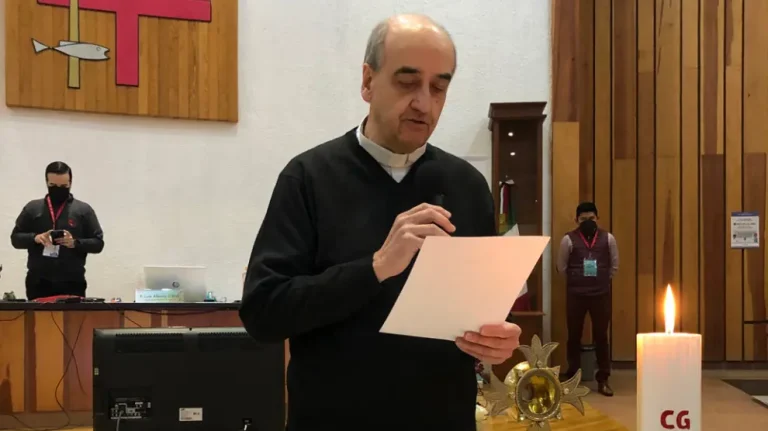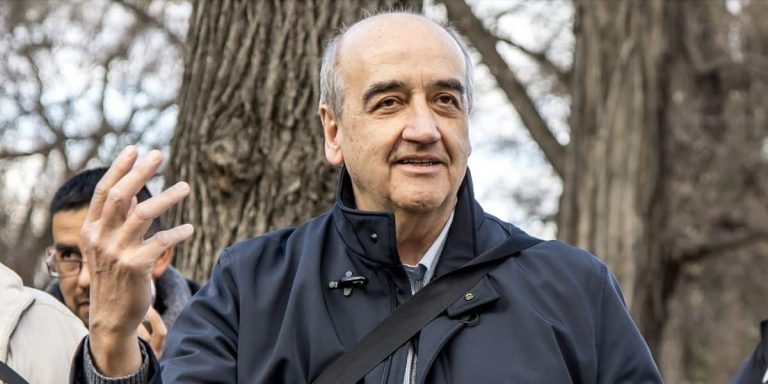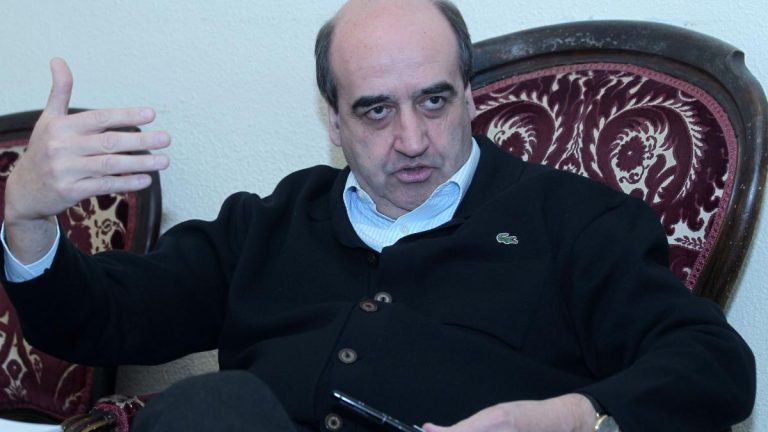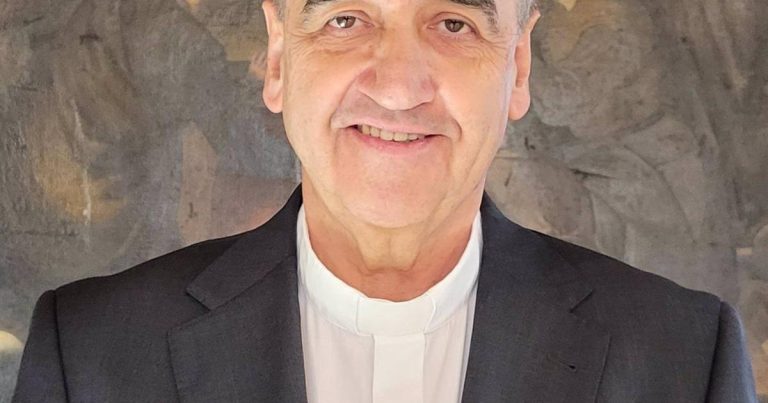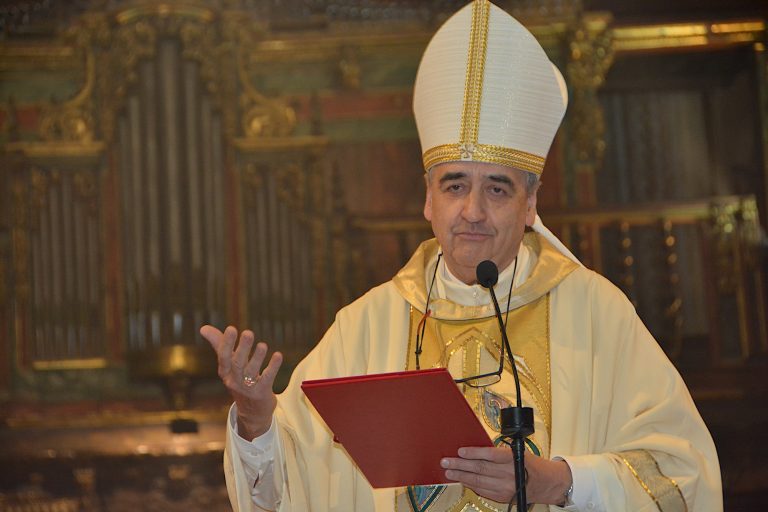


Newly Consecrated Bishop, former Superior General of the Piarist Order Pedro Aguado Cuesta
“The essence of journalism is dramatic. The authentic journalist conceals his own story and reveals that of others; he gathers dispersed vibrations and transmits them; like an actor, he disappears beneath the reality he conveys.”
— Rafael Barrett
Former Superior General of the Piarists and now Bishop of Huesca-Jaca, Spain, Pedro Aguado Cuesta once stood at the center of a carefully balanced ecclesiastical structure. Facing him today is Javier Alcántara, a survivor of clerical abuse in Mexico, whose persistence has begun to expose the inner mechanisms of protection, silence, and institutional delay that surrounded Aguado’s ascent.
This second part of our exclusive conversation with Javier Alcántara reveals an ecclesiastical network far more complex than initially apparent. As new victims find the courage to speak publicly, and as the Piarist Order is forced to justify documents it kept hidden for years, senior prelates in Mexico and Spain have begun to move. Alcántara—speaking with the precision of someone who has spent years untangling power structures—details how both formal and covert protection systems are reacting to his case, and to the tightening scrutiny now surrounding Pedro Aguado.
Good reading.
The Jacques Pintor team
Javier Alcántara Speaks
(Part Two of our exclusive interview)
Jordi Picazo (JP): Javier, let us pick up where we left off in our previous conversation. You were explaining that, following your podcast, the cardinal began to move. What has happened exactly?
Javier Alcántara (JA): I am also in contact with a person in Colombia. The Piarists already replied to them, but the response is the same as always—empty, without any operational content. I need to review that point with him, because the victim from Abella has just gone public; he published a written statement, and to a large extent that happened thanks to my case. That is positive—he found the courage to speak.
What we want now is to close the circle around Pedro Aguado and force him to speak. His silence works in his favor, but it harms the victims and those of us trying to clarify responsibilities.
Just last week (November 2025), the Archdiocese of Mexico sent a document to the Vatican Dicastery for Religious Life stating that the Piarists only reported on 14 August 2025 that Miguel Flores had lost his clerical state. Previously, they had denied the very existence of such a sentence: “We do not have it.”
Yet Pedro Aguado had previously assured that the sentence would be archived in the Order’s general archive, in the archive of the Bishop of Tlaxcala (the diocese of Miguel’s baptism), and that a copy would be sent to the Mexican Bishops’ Conference. However, both the Conference and the Bishop of Tlaxcala categorically denied possessing any such document.
In other words: the sentence exists, but it is hidden or outside the institutional channels that should safeguard it.
JP: That is how these criminals “cover their backs.” Look: after I had spent a year denouncing the practices of the bishop who preceded Pedro Aguado—Monsignor Julián Ruiz Martorell—the man suddenly published a safeguarding protocol for minors in his diocese and promoted it with great fanfare. That was in 2023, when he should have had such a protocol ten or fifteen years earlier.
And there is more: at that time, he had just appointed a newly ordained sexual deviant—whom he himself had ordained—as head of catechesis for the minors, despite having known him since childhood and despite having been warned by the Aragonese curia that he could not ordain him. They have now abandoned that project, lest they suffer “persecution” for being too cautious—what a joke.
Today, the Diocese of Huesca-Jaca simply redirects from its website to the lethargic, generic safeguarding text shared by the Aragonese dioceses.
JA: The same with the Piarists. The very day El País published its article, they rushed to publish a protocol, and the next day they held an express safeguarding congress. That part is crystal clear.
The Archdiocese’s argument is that they did not know Miguel Flores no longer had clerical status. The worst thing they claimed is that he was never in those parishes, that he was only registered in Mexico City.
That is what I know for certain. I have not spoken directly with Cardinal Carlos Aguiar Retes. I spoke instead with the Archdiocese’s safeguarding officer, Zaira Rosales. She contacted me saying, “The Cardinal is very interested in helping you,” and sent me a form to complete so they could forward it to the Dicastery for Bishops, possibly attaching it to the case of the Bishop of Cádiz.
As soon as my podcast was released, Cardinal Aguiar began to move. Suddenly, the documentation was ready to be sent to the Dicastery. And that is fine—because it is exactly what I had asked from the very beginning: that he use his direct line to the Dicastery for Bishops and clearly state what was happening.
JP: You mean, to take seriously the issue of Pedro Aguado’s cover-up.
JA: Exactly.
JP: Do not be surprised if they try to apologize and stop this from going any further. And the matter of the Bishop of Cádiz in Spain is not resolved by Pope Leo XIV merely accepting his resignation. What would correspond is a clear, public, disciplinary reduction to the lay state. The fact that your case exists before Mexican justice is already a significant achievement. When the steps are taken properly, the locks are set.
JA: Exactly. The Archdiocese told me that they would submit the complaint, the Dicastery would acknowledge receipt, and that would be it. The Cardinal said: “We will act as an intermediary—ensuring it arrives—but the Dicastery will have to contact you directly.”
I asked them to inform me once the document had arrived, because I drafted it myself. Then the Dicastery must inform us whether they are truly working on it—or else we begin to expose the Dicastery itself. In the end, they are the ones who must respond.
JP: In the Dicastery for Bishops sits Cardinal Juan José Omella, who managed the entire criminal entanglement in Aragón. After years of our investigation and the hand-delivery of documents to the Apostolic Nuncio in Spain—documents I personally delivered—canonical proceedings were initiated, and the agents of Cardinal Omella and of the Jesuit Father Arana were judged and condemned within the corridors of the Diocese of Zaragoza.
JA: That worries me. If Cardinal Omella is in that Dicastery, that could be a major obstacle.
JP: He is there, as is Bishop Satué, and several other Aragonese figures, including Rev. Fernando Arregui—the one who warned Monsignor Julián Ruiz that he could not ordain the deviant López-Brea I mentioned earlier. It complicates everything. But you are leaving a clear record of the facts, before those who are duty-bound to hear them.
JA: That is precisely why Cardinal Aguiar wants to “help” me—quotation marks intended. Also because I exposed him publicly. And I exposed the safeguarding bishop, Javier Acero, a Spaniard. I told the truth: they had done absolutely nothing. All they offered me was a hug and the assurance that God was with me.
Now, of course, they are moving. On the criminal case, we are awaiting summonses.
JP: Perfect. The essential point is what you said earlier: leaving a record. One cardinal replaces another. One pope replaces another. What remains is the file—if it is properly built.
JA: Exactly. I do not want to assume anything yet. But I understand that Pedro Aguado obtained the bishopric partly because of his presence in the Dicastery for Education. And there is more: for years he cultivated a friendship in the Vatican with someone very close to Pope Francis. According to Aguado himself, that relationship is what placed him there.
JP: Institutionally, it does not raise alarms. The holy founder of the Piarist Order, José de Calasanz, was Aragonese. Externally, it may appear logical that the former Superior General of the Piarists would return to Aragón as bishop.
JA: But my point is different: Pedro Aguado functioned as a firewall. He was placed there to protect certain matters and prevent others from exploding. And you know the official narrative: “Pedro Aguado did everything right,” “he controlled all abuse cases,” “there are no pending complaints.” That is the Order’s discourse.
What they did not expect was for me to speak. They thought they had me under control.
JP: But you are not controllable. Allow me the image: you are like an SAS soldier. You move pieces with clarity, agility, and without blinking. That disorients them.
If the document exists—and it does—why is it outside the institutional channels? Why is it not where it should be?
You May Also Read
- Report on the Legal Responsibilities of Pedro Aguado Cuesta (following soon)
- Two video interviews with the victim, recorded in Mexico (following soon)
Editorial Note: As the victim explains and corrects during the interview, the abusive priest was a Piarist, not a Legionary of Christ.
This article was first published on November 27, 2025.
By Jacques Pintor.
All rights reserved, @jacquespintor 2026.
For contact, you may want to write to us at jacquespintor@gmail.com.
Find us on Twitter @jacquesplease.