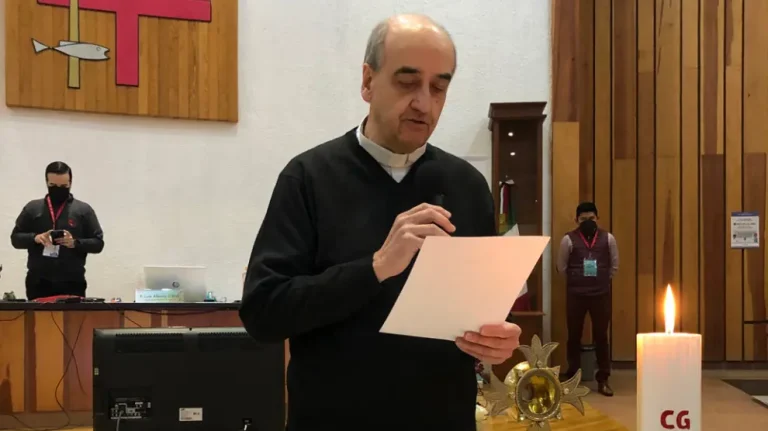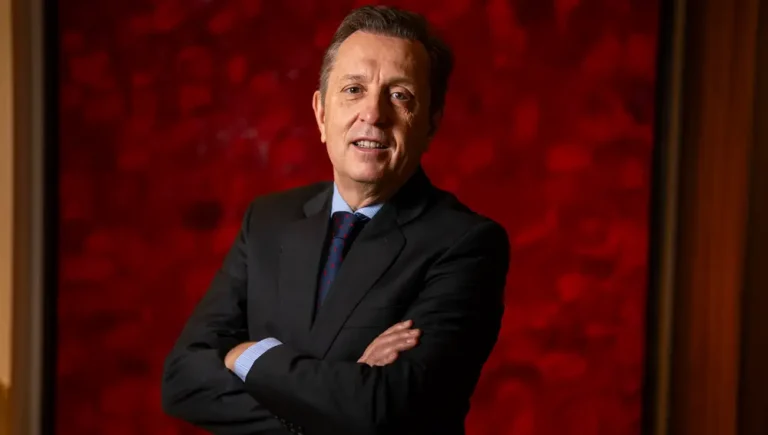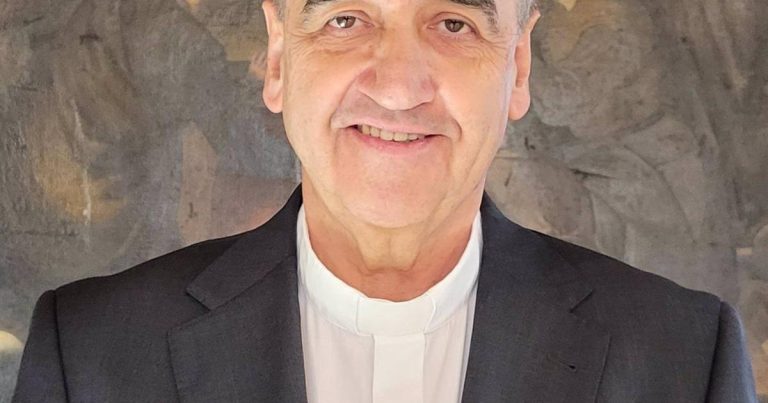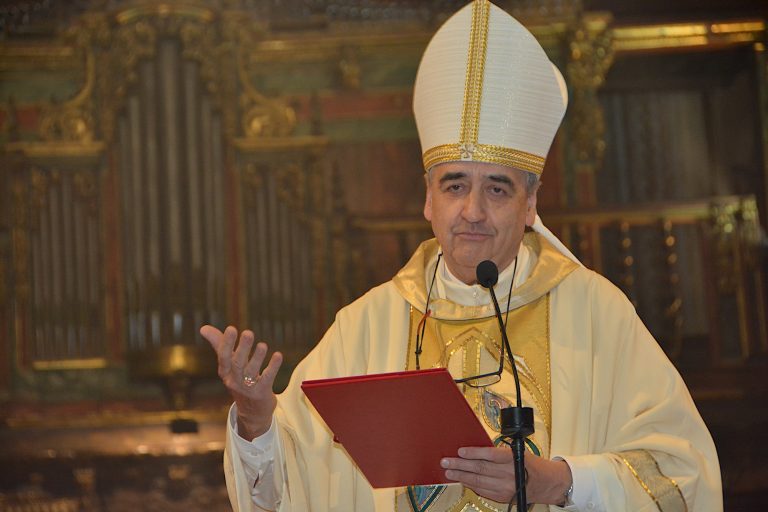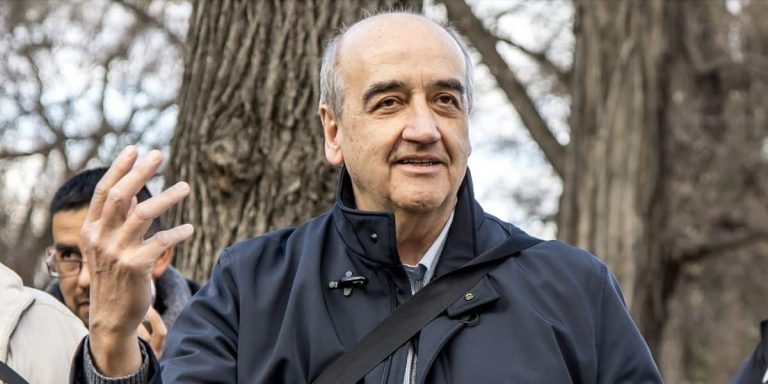

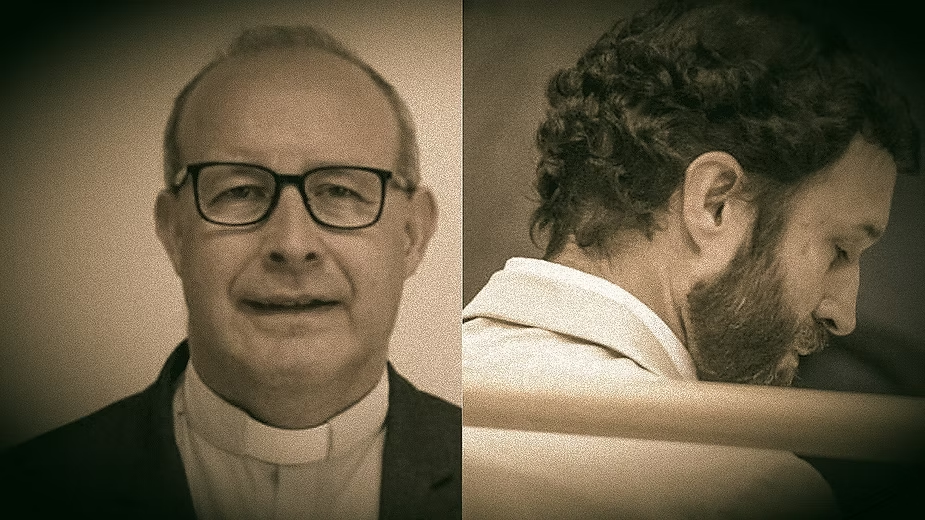
Monseñor Satué, ahora obispo de Málaga en España, y Chema Martínez, el profesor acusado de un delito y condenado por algo que nunca fue probado.
The case known as the Gaztelueta Case is a highly mediatised dossier concerning sexual abuse allegedly committed at Gaztelueta School (an Opus Dei school located in Leioa, Bilbao, Spain), involving a layman, José María Martínez, a member of Opus Dei and a former teacher at the school.
In September 2022, Pope Francis ordered the ecclesiastical reopening of the case, which had already been adjudicated in 2015 by the Congregation for the Doctrine of the Faith (then under the presidency of the Jesuit Cardinal Ladaria), resulting in an acquittal after a meticulous process involving interviews with the parties and a thorough examination of the evidence and allegations submitted by the complainant.
The papal decision to “retry” the case responded to a request made by the complainant—the alleged victim, described by various voices as a liar—expressed during a television programme in which he appeared together with Pope Francis. That media appearance caused widespread astonishment due to its overtly propagandistic nature. It was the first time the Vatican subjected a layperson to canonical proceedings for allegations of sexual abuse; moreover, this occurred despite the fact that the individual had already been tried and acquitted, constituting a blatant violation of the principle of non bis in idem.
The annulment of a prior procedure that had concluded with acquittal represents a watershed moment for the credibility of the Catholic Church. To the repetition of the trial—clearly aimed at formalising a conviction—was added the extraordinary circumstance that the decision was taken by a Pope during a television programme conducted by a populist interviewer, at the request of the alleged victim, causing widespread dismay.
Pope Francis entrusted the new instruction of the case to Monsignor José Antonio Satué, appointing him Delegated President (judge) of the special canonical tribunal constituted for this purpose. The designation of a relatively new bishop (Satué was consecrated in 2021) to such a sensitive case was interpreted by some as evidence of the Pope’s direct confidence in Satué. Father José Luis Perucha, then rector of the Seminary of Sigüenza–Guadalajara, was appointed notary. Legal advisers included Myrian Cortés, Rector of the Pontifical University of Salamanca—already involved in an academic extortion scandal linked to Cardinal Omella—and Father Federico Mantaras.
The Diocese of Bilbao publicly announced that the Pope had entrusted Bishop Satué with the gathering of evidence and the possible canonical trial related to Gaztelueta. Satué’s role in this special ecclesiastical tribunal has not been without controversy. From canonical law circles and from certain media outlets, the opacity of the process has been denounced, and the legitimacy and conduct of the new trial have been openly questioned.
Legal experts—including constitutional law professor Fernando Simón Yarza of the University of Navarra—and voices close to the accused have warned that fundamental principles essential to any fair trial may have been violated: judicial impartiality, equality of arms, presumption of innocence, non-retroactivity of criminal law, and the prohibition of non bis in idem. The accused himself, José María Martínez, has described the renewed canonical proceedings as “an abuse of power”, while reiterating his innocence.
A Canonical Sentence Conceived Before the Trial
Throughout 2023 and 2024, a series of controversial incidents occurred during the proceedings presided over by Satué. At one point, Bishop Satué recused Martínez’s defence lawyers, who had already been formally admitted, forcing the accused to seek new legal representation. On another occasion, the defence denounced the failure to deliver the Vatican decree reopening the case, meaning that the defence formally did not know under which specific charge their client was being tried (whether a canonical crime or an infringement of Opus Dei statutes).
There was also a lack of clarity regarding the legal nature of the proceedings, as implicitly acknowledged by the Apostolic Signatura, the Supreme Tribunal of the Church, in somewhat evasive responses. A particularly serious episode occurred in February 2024, when Satué denied the appearance of a key defence witness: the priest Silverio Nieto.
Nieto had been responsible for the preliminary investigation of the case in 2015 on behalf of the Congregation for the Doctrine of the Faith—an investigation that concluded with the dismissal of the accusations and an instruction to restore the good name of the accused teacher. Satué’s decision to block the testimony of the individual with first-hand knowledge of the prior, exculpatory investigation was widely criticised, as it constituted a denial of the principle of audi alteram partem—the right to hear the other side—essential to any fair judicial process.
According to the religious news outlet Religión Confidencial, it was Satué himself who “did not consider it appropriate” for Silverio Nieto to testify at the hearing held in Pamplona, despite the defence’s request. Other defence witnesses were heard, including administrators and teachers from Gaztelueta School and an education inspector from the Basque Government, all of whom had participated in the civil proceedings and whose statements reinforced the accused’s version of events. The Provincial Court of Biscay, however, had previously ridiculed these witnesses before sentencing Martínez to eleven years in prison.
In the civil jurisdiction, the Spanish Supreme Court reduced the sentence imposed on teacher Chema Martínez by the Provincial Court of Biscay from eleven years to two years. The Supreme Court partially upheld Martínez’s appeal and rejected two of the five elements used to justify the severity of the original sentence. This reflects the principle of in dubio pro reo, which requires that doubt be resolved in favour of the accused.
“At the Supreme Court, we believe Chema Martínez is innocent,”
confided Judge Manuel Marchena, President of the Second Criminal Chamber of the Spanish Supreme Court, to jurist Benigno Blanco in a private conversation.
Although not an official statement, it clearly reflected the prevailing atmosphere behind the scenes at Spain’s highest court: a growing conviction that Chema Martínez—former Gaztelueta teacher and Opus Dei member—had been convicted without evidence, and that the proceedings against him were, at the very least, deeply irregular.
It has been noted that the investigative phase and witness examinations in the reopened canonical process had to be “granted” only after persistent requests by Martínez’s legal team, not at the initiative of the tribunal itself, and that progress was achieved only after appeals to the Apostolic Signatura of the Holy See. Even so, when witness hearings began in 2024—nine years after the first process that resulted in canonical acquittal—Martínez’s legal representation still had not received either a copy of the reopening decree or a formal bill of indictment specifying the alleged new evidence. Legal experts consider this a serious violation of the right to defence, within and outside the Catholic Church, in any legal system worthy of the name.
The legal scholars who signed the document Elements for the Verification of the Innocence of José María Martínez Sanz described it as “untenable in any legal system” that earlier investigations and procedural acts were not incorporated into the main proceedings, and criticised Bishop Satué for appearing to “opt for having less information rather than more—unless everything had already been decided.”
Only our investigative team “Jacques Pintor” has reported the confession attributed to Judge Marchena—likened to Pontius Pilate condemning an innocent man out of fear of the crowd—relayed to Benigno Blanco by direct sources within Blanco’s personal circle.
Benigno Blanco’s Assessment
Several years later, on 2 April 2025, Benigno Blanco published his opinion on page three of the Spanish daily ABC:
“The following reflections were prompted by my reading of the decree (the sentence, in civil terms) by which the Bishop of Teruel [Satué] condemns José María Martínez, former teacher at Gaztelueta School, to expulsion from Opus Dei. Mr Martínez was judged by the judge predetermined by canonical law—the Congregation for the Doctrine of the Faith—and acquitted; he is now judged again by a judge appointed ad hoc, outside any predetermined procedure and applying laws retroactively. The bishop-judge rejected (without any stated reasoning in the decree) most of the evidence proposed by the accused, who was also prohibited from being defended by the lawyers of his choice. The decree contains not a single word on the presumption of innocence, which has therefore been disregarded. The bishop relies exclusively on expert reports submitted by the complainant and dismisses—without assessment—the defence experts, repeating the same defect identified by the Spanish Supreme Court when reviewing the Biscay court’s handling of the case, even though that Supreme Court ruling is cited by the bishop as a relevant precedent.”
During the proceedings, José Antonio Satué repeatedly demonstrated a lack of impartiality, including sending a letter to Chema Martínez urging him “to recognise the truth and ask forgiveness” of the alleged victim before any judgment had been issued. The content of that letter—going far beyond procedural formality—has been widely criticised and reinforces the perception of Satué’s alignment with the prosecution.
The Gaztelueta Case has therefore placed Bishop Satué’s conduct as an ecclesiastical judge under public scrutiny. His procedural decisions were described as a “strongman move” by digital outlets such as InfoVaticana, cited as examples of abuse of power and procedural arbitrariness due to the manifest violation of the right to defence—already highlighted by the Spanish Supreme Court. Some analysts fear the case may set a dangerous precedent for legal guarantees within the canonical jurisdiction of the Catholic Church.
From the Report of Professor Fernando Simón Yarza
What follows is a section of the analysis I carried out in my book Operation Opus Dei, concerning the appointment of Satué as president of what is, in effect, a tribunal of exception, criminal in nature. In one of the chapters of the book, I dissect the study by Professor Fernando Simón Yarza.
From Yarza’s report, I highlighted the following passages in my book:
(7.) I now turn to another illegitimate aspect of the case before us, namely the appointment of Monsignor José Antonio Satué Huerto, Bishop of Teruel, as Delegated Investigator of the case.
(a.) Judicial impartiality constitutes, in the words of the Spanish Constitutional Court, the “defining characteristic of any judicial body” and “the principal requirement of the right to the lawful judge” (STC 106/1989, 8 June, Legal Ground 2). The right to the ordinary judge requires judges to be subject to a common regime or statute, that is, they must not be exceptional bodies or bodies created ad hoc. This is a constant in comparative law and an essential guarantee of any minimally civilised criminal system.
Article 6.1 of the European Convention on Human Rights states that “everyone is entitled to a fair and public hearing (…) by an independent and impartial tribunal established by law”; and Article 47 of the Charter of Fundamental Rights of the European Union affirms that “everyone is entitled to a fair and public hearing within a reasonable time by an independent and impartial tribunal previously established by law.”
The guarantee of a lawful judge is unanimously recognised—under different names—across the States of the Council of Europe (ECtHR Guðmundur Andri Ástráðsson v. Iceland (Grand Chamber), 1 December 2020, §§ 148–153). The expression “tribunal established by law” “reflects,” according to the European Court of Human Rights, “the principle of the rule of law inherent in the system of protection established by the Convention [for the Protection of Human Rights and Fundamental Freedoms] and its Protocols, and which is expressly mentioned in the Preamble to the Convention” (ibid., § 211). This guarantee seeks, nothing less, than “to safeguard judicial independence” (ibid., § 215).
(b.) In the case at hand, it is not even clear whether an investigative body has been appointed, as the note itself ambiguously refers to what is expected of “this process.” The appointment of an ad hoc investigator should not be equated, strictly speaking, with the creation of a special or exceptional judicial body; nevertheless, it still constitutes a double violation of the right to the ordinary judge, predetermined by law:
(1º) First, it manifestly contravenes canon 1717 of the Code of Canon Law, which unequivocally assigns the competence to initiate proceedings and appoint the investigator to the Ordinary:
“Whenever the Ordinary has knowledge, at least verisimilar, of a delict, he is to investigate carefully, personally or through a suitable person, the facts and circumstances, as well as imputability, unless such an investigation appears entirely superfluous.”
It is the Ordinary of the place who, based on his close and particular knowledge of the case and his jurisdictional responsibility, receives from the law of the Church the authority to initiate the investigation. We are dealing with a norm whose foundation in justice is so evident as to require no further explanation. Moreover, there is no doubt that in no case would this be a delict reserved to the Holy See.
Certainly, some might think that, by virtue of his supreme authority, the Roman Pontiff has no obligation to respect canonical legality. This, however, would amount to confusing the theological and juridical meaning of the Petrine ministry with a licence for arbitrary authoritarianism, detached from the law—a legibus solutus.
(2º) In addition, it must be emphasised that the choice of Monsignor Satué as Delegate of the Holy See to instruct the case was made without any motivation whatsoever regarding his suitability ad casum, which contradicts another requirement of canon 1717.
Despite all this, José Antonio Satué has been portrayed—according to Vida Nueva in its digital edition—as a dynamic and approachable bishop, well regarded in his former diocese, with a trajectory marked by the trust placed in him by superiors, both locally and in the Vatican. The challenge remains to respond to that trust with transparency, justice, and fidelity to the evangelical ideal—especially when the facts speak for themselves.
Silverio Nieto and Myriam Cortés
The Vatican appointed Silverio Nieto Núñez, a priest with a highly unusual biography, who until recently served as Director of the Civil Legal Service of the Spanish Episcopal Conference (CEE)—a position he assumed in 2002—accompanied as an advisory member by Myriam Cortés, Rector at that time of the Pontifical University of Salamanca (UPSA).
Also a member of the CEE’s legal service was Cardinal Lluís Martínez Sistach, now Archbishop Emeritus of Barcelona, accused together with Cardinal Omella by the newspaper El País of concealing cases of paedophilia in his diocese for decades.
Myriam Cortés was appointed by Cardinal Omella as a member of the illegal tribunal against the former Gaztelueta teacher. In the past, Cardinal Omella had threatened and bribed Myriam Cortés to secure the approval of a previously failed doctoral thesis of a priest close to Omella, Rev. Ramón Batlle, former director of the Higher Institute of Religious Sciences of Barcelona, who had previously been expelled from the seminary of La Seu d’Urgell in Spain.
The appointment of Cortés to this criminal tribunal, even without adding further perversity to the case, would already be highly problematic due to the cardinal’s moral authority and ascendancy over her. What is now being asked—or appears to be being asked—is that she return the favour, ensuring a priori the conviction of a man who, to this day, has not been proven guilty. The very President of the Second Criminal Chamber of the Spanish Supreme Court, Judge Manuel Marchena, commented privately that they are convinced at that level that the former Gaztelueta teacher is innocent.
Crisis in the Rectorate of the Pontifical University of Salamanca
The online outlet Religión Confidencial, close to Opus Dei and staffed by several members of the Prelature, reported on the irregular and surprising circumstances surrounding the election—or rather re-election—of the Rector of the Pontifical University of Salamanca, who obtained fewer votes than her closest rival.
Some expressed surprise; others interpreted this favouritism as the quid pro quo for the threat described by Mari Carmen Amador to our colleague Jordi Picazo, allegedly made by Cardinal Omella unless she approved the previously failed doctoral thesis of Ramón Batlle. Once the thesis was approved, Cortés secured a second term.
One striking fact is that under the current rector, the Pontifical University of Salamanca—owned by the Spanish Bishops’ Conference—fell to the bottom of the rankings published by El Mundo. None of its degrees ranks among the best in Spain in any category.
Had she not been placed in that position as a result of having done a favour under coercion to Cardinal Omella, could it be argued that she was appointed rector because she was the most qualified, in light of these results? This is how the Salamanca-based digital newspaper reported it (bold emphasis mine):
“Of the 84 universities in Spain (including 48 public and 36 private), a total of 45 have at least one degree recognised among the best in the country. In this twenty-first edition of the ranking, the Pontifical University ranks at the bottom alongside another 38 institutions that also fail to place any of their degrees among the best. The Pontifical University of Salamanca does not manage to place a single degree among the best in the country, either at its Tormes headquarters or at its Madrid campus.”
The New Canonical Action
(page 11 of the Simón Yarza report, from the analysis in the book Operation Opus Dei*)*
On 15 September 2022, the Bishop of Bilbao, Monsignor Joseba Segura Etxezarraga, stated the following in a public note (Informative Note of the Bishop of Bilbao on the latest developments in the Gaztelueta Case, 15 September 2022):
“The Holy Father became aware, in December 2014, of allegations of abuse of a minor against a teacher at Gaztelueta School, in Bilbao (Spain). Since then, he has closely followed the situation of the persons involved and the various actions taken by Spanish courts and by the Church.
At this time, he has deemed it appropriate to order the instruction of a canonical process, entrusted to Monsignor José Antonio Satué Huerto, Bishop of Teruel and Albarracín. The Reverend José Luis Perucha Rojo, Rector of the Seminary of the Diocese of Sigüenza–Guadalajara, will act as notary. Dr Mirian Cortés Diéguez, Rector of the Pontifical University of Salamanca, and the Reverend Federico Mantaras Ruiz-Berdejo, Vicar General of the Diocese of Asidonia-Jerez, will act as advisers.
This process seeks to clarify responsibilities and to help heal the wounds caused.”
† Joseba Segura, Bishop of Bilbao (Bilbao, 15 September 2022)
Nine days later, on 24 September 2022, Monsignor Segura stated the following in an interview on Radio Popular:
“As far as I am concerned, all I did was publicly communicate that the Vatican asked me to make a certain announcement stating that the instruction was being opened and that the aim was to heal wounds. That was my role at the time. Subsequently, a major public debate arose as to whether the Church can or cannot carry out an instruction involving a lay person, directed at a lay person. I have no criterion on that matter because I do not know exactly how the instruction is being framed; the only thing I know is what I stated that day in the note.”
(Interview with Monsignor Segura on Radio Popular, 24 September 2022; podcast archived and consulted on 22 October 2022.)
In a letter dated 26 September 2022—to which I had access while preparing this opinion (note: several weeks after the news appeared in the media, the letter was sent to me by the investigated party at my request)—the Bishop of Teruel and Albarracín, Monsignor José Antonio Satué Huerto, addressed the investigated party:
“in my capacity as Delegate of the Holy See to instruct the canonical procedure relating to the complaints lodged by Mr Juan Cuatrecasas Cuevas against you.”
Key Legal Content of the Letter
a) The letter informs the investigated party that:
“a penal administrative procedure will shortly be initiated, pursuant to canon 1720 of the Code of Canon Law, for a delict against the sixth commandment of the Decalogue with a minor, typified in canon 1398 §§ 1–2.”
Canon 1398 provides:
Canon 1398 § 1. A cleric is to be punished with deprivation of office and with other just penalties, not excluding, if the case so warrants, dismissal from the clerical state, who:
– commits a delict against the sixth commandment of the Decalogue with a minor or with a person who habitually has an imperfect use of reason, or with one to whom the law grants equal protection;
– recruits or induces a minor, or a person who habitually has an imperfect use of reason, or one to whom the law grants equal protection, to expose themselves pornographically or to participate in pornographic exhibitions, whether real or simulated.
Canon 1398 § 2. If a member of an institute of consecrated life or a society of apostolic life, or any of the faithful [i.e. non-clerics], who holds a dignity or performs an office or function in the Church commits one of the delicts listed in § 1 or in canon 1395 § 3, they are to be punished in accordance with canon 1336 §§ 2–4, with the addition of other penalties according to the gravity of the delict.
It is debatable whether the case at hand, even under this new formulation, can be subsumed under this ecclesiastical penal norm; but it certainly could not be at the time the alleged facts were said to have occurred.
b) Monsignor Satué further informs the investigated party that:
“the Holy Father has ordered that the law currently in force be applied, and not that which was in force at the time the alleged facts may have occurred, derogating what is provided in canon 1313 § 1.”
Canon 1313 § 1 explicitly enshrines the principle of non-retroactivity:
Canon 1313 § 1. If the law is changed after a delict has been committed, the law more favourable to the accused is to be applied.
c) It is also ordered that, on a supplementary basis, in all matters not provided for by the current Code:
“the Norms on delicts reserved to the Congregation for the Doctrine of the Faith, approved by Rescripta ex Audientia of 3 and 6 December 2019, as well as those of 11 October 2021, shall serve as reference legislation, taking into account numbers 91–129 of the Vademecum on certain procedural questions in cases of sexual abuse of minors committed by clerics.”
d) In assessing this discretionary choice of applicable criminal law, it is essential to bear in mind that:
(1) the dates on which the accuser claims the alleged acts occurred correspond to the academic years 2008–2009 and 2009–2010; and
(2) the investigated party is not a cleric.
e) Monsignor Satué informed the investigated party of the possibility of appointing a procurator and/or lawyer:
“within a period of seven working days”
from receipt of the letter, either personally or by certified post to the Diocese of Teruel and Albarracín. He further warned that:
“a summons will subsequently be received, at which point the process will formally begin.”
f) Finally, the Delegated Investigator addressed the investigated party in the following terms:
“Finally, as a brother in the faith, I respectfully allow myself to recommend that, if for whatever reasons you have defended your innocence in an uncertain manner, you consider this procedure as an opportunity to recognise the truth and ask forgiveness from Mr Juan Cuatrecasas Cuevas and his family.”
Jordi Picazo
#CanonicalJustice #AbuseOfPower #CourtOfException #VaticanAccountability #EcclesiasticalJustice #ChurchGovernance #EcclesialTransparency #TheGazteluetaFile #InvestigativeJournalism #OpusDei

For documentation, other Media reports and more, you may want to relate to this post in Spanish in this Site. Readers are invited to comment responsibly and to contribute documented information that may help clarify the facts. We invite readers to leave their comments, analyses, or contributions at the end of this entry. A respectful, fact-based debate is an essential part of accountability.

All rights reserved, © @jacquespintor 2026. For contact: jacquespintor@gmail.com Find us on X / Twitter: @jacquesplease