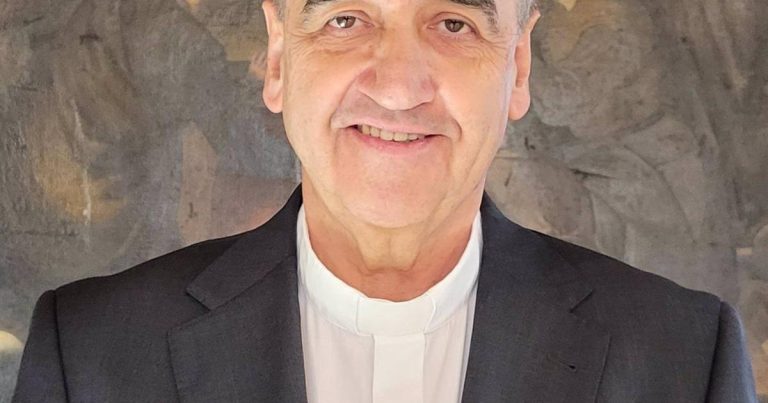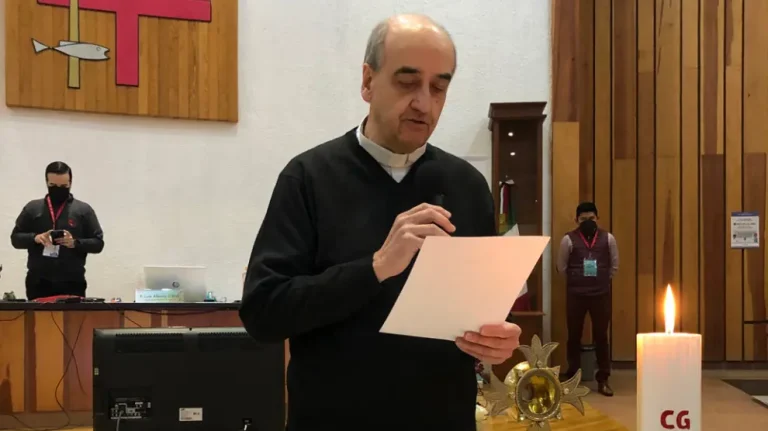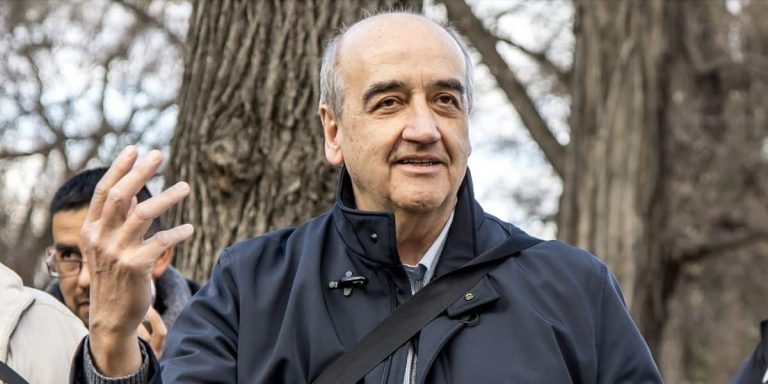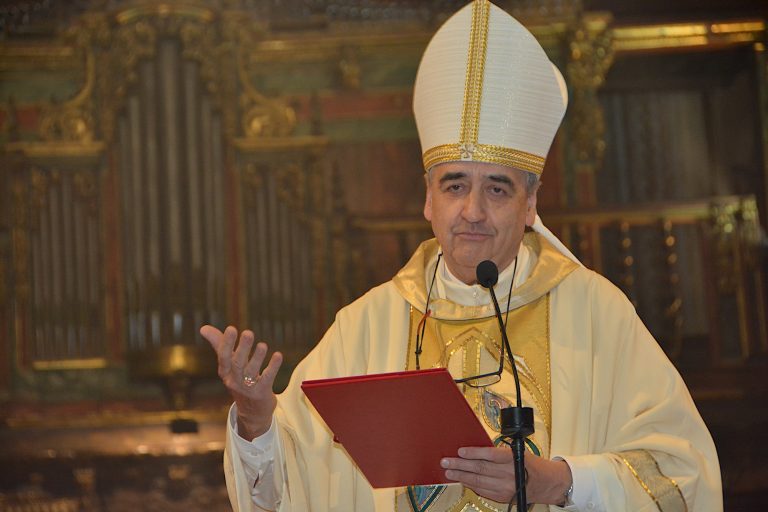

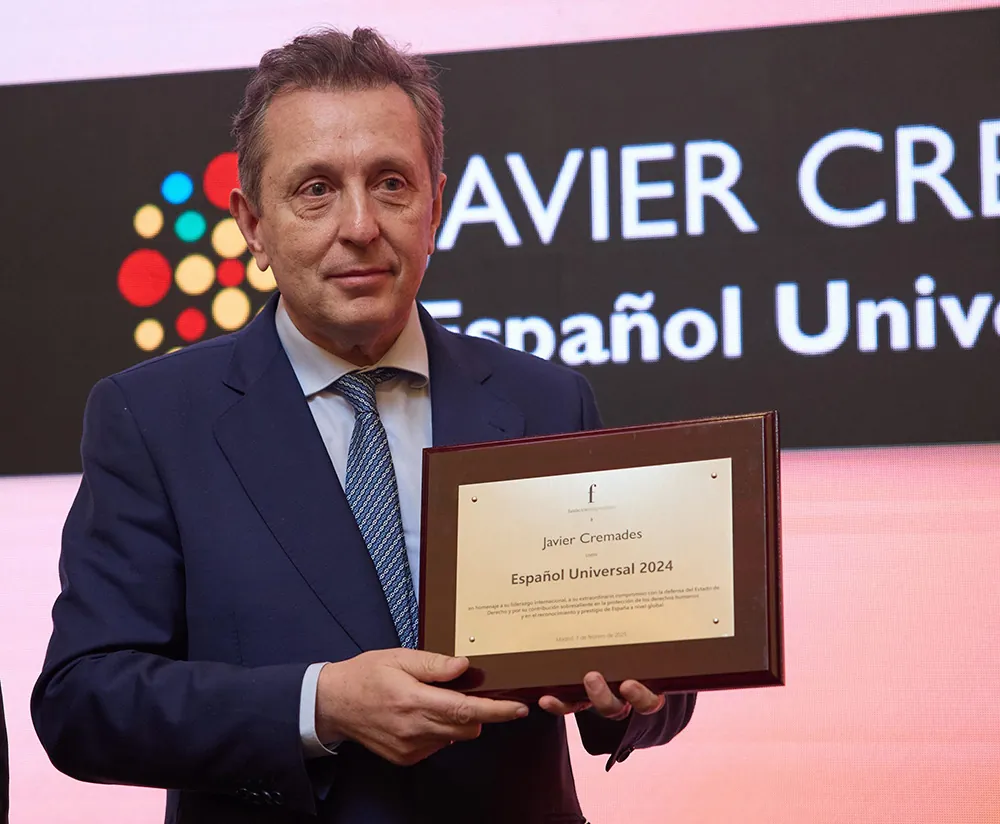
Javier Cremades, President of the World Jurist Association and of the Madrid-based law firm Cremades & Calvo-Sotelo, receiving the Universal Spaniard Award.
This case focuses on Jordi Picazo, an investigative journalist and the only Spain-based member of the international Jacques Pintor team, who is facing criminal complaints, claims for extraordinarily severe financial damages, and personal restrictions as a direct consequence of his journalistic work.
These proceedings arise in a context in which the facts under investigation have had clear political, institutional, and ecclesial repercussions, raising questions that extend beyond the individual case and directly concern readers and public opinion.
1. Public Coherence
If a law firm leads audits on abuse, transparency, and institutional reform within the Catholic Church under a direct mandate from the Spanish Episcopal Conference, how should society assess the fact that one of its integrated firms is pursuing criminal and financial actions against a journalist who investigates and reports precisely on those abuses and institutional dysfunctions?
2. Knowledge, Proximity, and Responsibility
Can it reasonably be maintained, in terms of professional diligence, that Javier Cremades was unaware that the Pajares firm—led by its owner José Pajares in Zaragoza and operating as the regional representative of Cremades & Calvo-Sotelo in Aragón—was acting against an investigative journalist, when he had at least three personal meetings with that journalist (one during a walk and two in his professional office), received from him—at his own request—the books resulting from the investigation, and was directly familiar with the substance of the case?
And if he was nevertheless unaware, what does this indicate about the internal mechanisms of oversight, information flow, and accountability within a firm that publicly presents itself as a guardian of the rule of law?
3. Assistance Offered, Withdrawn, and Conditioned
When the head of an internationally prestigious law firm offers assistance to a journalist with words such as “if you need help, let me know” (Javier Cremades to Jordi Picazo, in relation to the complaint against Picazo led by Cremades’ partner in Zaragoza), and later states “I cannot help you,” conditioning any possible solution on the journalist ceasing to write about the case alleging failures of compliance within the Catholic Church,
are we dealing with a legitimate handling of a complex conflict, or—at least from the perspective of a reasonable observer—with an indication of pressure that is difficult to reconcile with the public defence of fundamental freedoms that the same firm proclaims?
4. Proportionality, Coercion, and Real Impact
When a journalist is required to provide deposits, faces asset seizures, fines, and compensation claims amounting to hundreds of thousands of euros, and has his passport withdrawn or its renewal effectively prevented, can such measures be regarded as proportionate from a democratic standpoint, or is it legitimate to ask whether they constitute a mechanism of personal and economic coercion with a dissuasive effect on the freedom to inform?
5. The Public Prosecutor and Persistent Punitive Claims
If the Public Prosecutor states that no criminal offence is identified and acknowledges the informative purpose of Jordi Picazo’s professional activity as an internationally accredited journalist, how should citizens interpret the continued pursuit of prison sentences and financial ruin against the reporter?
Protection of rights… or exemplary punishment?
6. Aggravating Context, Funding, and Public Relevance
When the facts under investigation are not strictly private but have resulted in a political scandal involving the discretionary appointment—based on personal connections—of a priest to a senior public office;
when that priest allegedly neglected his pastoral duties during the relevant period, continued to receive diocesan financial support, and was ordained despite internal objections within ecclesiastical structures;
and when that same priest engages a top-tier law firm to pursue criminal and financial actions against the journalist investigating these facts, does this broader context not confer clear objective public relevance, reinforce the public-interest nature of the reporting, and require particular caution regarding any judicial action that could have an inhibiting effect on investigative journalism?
7. Who Pays for the Defence?
Given that a priest receives a limited and regulated income, is it legitimate for public opinion—without prejudging—to ask where the financial resources originate to sustain a high-cost legal strategy led by the same firm commissioned by the Spanish Episcopal Conference to audit clerical sexual abuse within the Church, while judicial proceedings against a journalist have now extended over four years?
And, where appropriate, can it be ruled out with full transparency that ecclesiastical funds—directly or indirectly—have been used to finance judicial actions aimed at silencing an investigation of undeniable public interest, involving controversial episcopal decisions and potential breaches of the canonical norms governing bishops’ conduct?
8. Final Question to the Reader
In light of all the above—the audit commissioned by the Episcopal Conference, the personal proximity between lawyer and journalist, the sums claimed, the requests for imprisonment, the withdrawal of the passport, the absence of criminal reproach by the Public Prosecutor, and the political impact of the case—what message does any journalist observing this situation from the outside receive today?
That rigorous reporting offers protection… or that it may carry a personal and professional cost that is scarcely compatible with a democracy?
Yanelis Tovar. Editor
How to follow this series
This investigation is published as an open, ongoing series, in which each installment adds a new layer of analysis on the use of the law as a tool of pressure against investigative journalism. The installments published so far are:
1. Press freedom under judicial pressure: eight public questions on the role of Javier Cremades and the Pajares law firm
An initial public challenge. Seven documented questions that do not accuse, but compel readers to take a position on coherence, proportionality, and the real impact of legal actions brought against a journalist. (This entry)
2. Javier Cremades, a necessary accomplice in a criminal scheme against investigative journalism
A direct contrast between institutional rhetoric about the rule of law and the legal practices deployed against a journalist investigating abuse and corruption. This installment exposes the breach between words and actions. 👉 https://corruptspanish.church/cremades-calvo-sotelo-cooperador-necesario-en-un-entramado-criminal-contra-el-periodismo-de-investigacion/
3. Javier Cremades and the mechanics of judicial persecution against investigative journalism
A detailed analysis of the how: criminal complaints, economic pressure, personal measures, and calculated attrition. Not a theory, but a recognizable mechanism with real deterrent effects. 👉 https://corruptspanish.church/javier-cremades-and-the-judicial-persecution-mechanics-against-investigative-journalism-3/
New installments will be added to this index as the investigation progresses.
Readers are invited to comment, provide information, and participate in a factual and respectful debate.

If any factual statement contained in this article is considered inaccurate, readers may contact the editorial team to exercise their right of reply or request a clarification or factual correction, in accordance with journalistic standards.

The editorial team is also available to grant interviews; this applies—subject to appropriate protective safeguards—also to some of the individuals concerned.

© Jacques Pintor, 2026. All rights reserved. Any reproduction or redistribution without prior authorisation is prohibited.
Contact: jacquespintor@gmail.com

#InvestigativeJournalism #RuleOfLaw #PressFreedom #SLAPP #PublicInterest #CremadesCalvoSotelo #InstitutionalTransparency #FreedomOfExpression #PressFreedom #InvestigativeReporting