

Sexual Abuse in the Catholic Church
A renewed call—on familiar ground
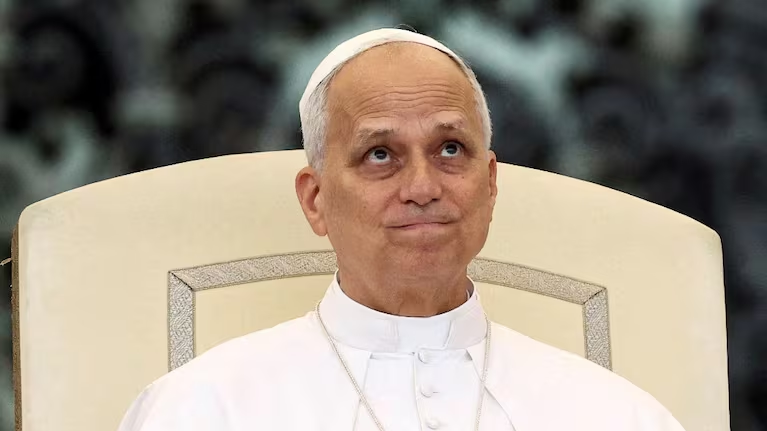
In February 2026, Pope Leo XIV once again placed the protection of children at the center of his public discourse. Speaking at the Vatican in the context of the initiative “From Crisis to Care: Catholic Action for Children,” he reiterated the need to safeguard minors, respect their dignity, and confront the structural injustices that continue to expose them to abuse, poverty, and exploitation.
The Pope’s message is clear in its moral framing: the suffering of children is not an abstract issue but a concrete injustice that demands coordinated, global action. He insists on a holistic approach —physical, psychological, and spiritual— while lamenting that, despite commitments, the situation of many children has not significantly improved.
This language is not new. It aligns with a decade of ecclesial discourse that presents child protection as a central moral priority. Yet the credibility of such statements does not depend on their formulation, but on their application.
A pattern already identified
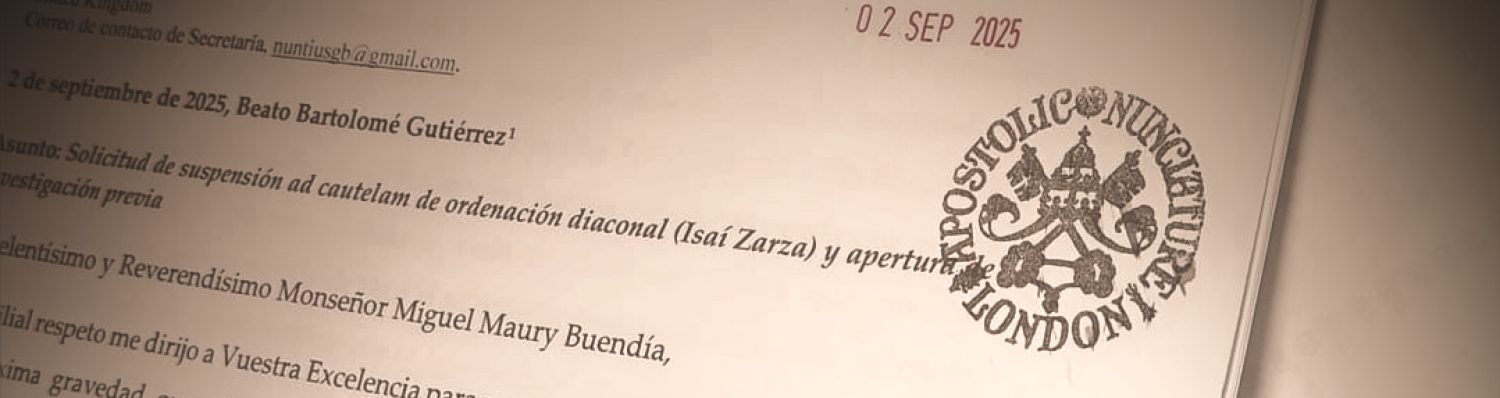
This is not the first time such a gap has been observed. As previously noted on this website, a Church that proclaims a culture of care proves its credibility not when it speaks about victims, but when it answers the letters that victims write.
That earlier analysis, centered on the case of Claudia —a Mexican mother who reported the repeated rape of her son and alleged institutional negligence — highlighted a structural tension: the distance between principles and practice.
Pope Leo XIV himself, in his message to the 2026 CEPROME Congress, stated unequivocally:
“Listening to victims is not an optional gesture, but an act of justice and truth.”
The formulation leaves little room for ambiguity. Listening is not pastoral sensitivity; it is justice. And yet, when confronted with documented complaints sent directly to Rome, silence persists.
The legal framework: promise and limitation
To understand this contradiction, it is necessary to examine the legal instrument that underpins the Church’s current safeguarding framework: Vos Estis Lux Mundi, promulgated in 2019 by Pope Francis.
The document was introduced as a response to the global abuse crisis, establishing universal procedures for reporting and investigating allegations. It marked a shift in tone by explicitly defining sexual abuse as a crime, not merely a moral failing.
As one academic assessment explains (Costigane, 2020):
“The apostolic letter… was an attempt to address the global scandal of sexual abuse within the Roman Catholic Church.”
It introduced several key elements:
- mandatory reporting obligations for clergy
- formal investigative procedures
- recognition of abuse of authority as a relevant factor
- explicit inclusion of child pornography as a delict
These provisions, on paper, appear to respond to long-standing criticisms.
The unresolved structural deficiencies
However, the same academic analysis identifies persistent weaknesses —weaknesses that are not marginal but structural.
On the one hand, there is the dependence on episcopal authority. The system relies heavily on bishops to investigate allegations, including those involving their peers. This creates an inherent conflict of interest:
“History has shown that not only did bishops fail to report abuse cases… but that they themselves were accused of perpetrating sexual abuse.”
The autonomy of bishops within canon law—described as legislative, executive, and judicial—limits effective accountability.
On the other hand, there is a lack of independent oversight. Although lay participation is permitted, it is neither mandatory nor structurally guaranteed:
“There is no mandatory involvement of lay people in the processes… the process… can be carried out entirely by clerics.”
This absence of independent scrutiny directly undermines transparency.
On the third hand, there is a legacy of secrecy. Historical handling of abuse cases has been marked by confidentiality regimes that, in practice, facilitated concealment:
“There is no doubt that these laws mandating secrecy exacerbated the sexual abuse scandal.”
Even where reforms have been introduced, the institutional culture shaped by decades of secrecy remains difficult to dismantle.
Last but not least, there is a conceptual ambiguity: vulnerability and power. The definition of “vulnerable persons” remains contested, failing to fully capture situations where abuse arises from power imbalances rather than inherent fragility. This gap is not theoretical. It affects how cases are classified, investigated, and ultimately judged.
From norm to practice: the contradiction in terminis
The contradiction emerges precisely at the intersection of these elements. On the one hand, Pope Leo XIV affirms that:
- listening to victims is an act of justice
- responsibility is personal and non-delegable
- safeguarding is essential to the Church’s mission
On the other hand, the operative framework:
- concentrates power in the hands of bishops
- lacks independent enforcement mechanisms
- permits institutional silence without immediate consequence
The result is not merely inconsistency but a contradiction in terms.
A system that defines listening as justice cannot remain credible when documented complaints go unanswered. A framework that proclaims accountability cannot depend exclusively on those whose accountability is in question.
The test of credibility
The Vatican speech on children’s rights reinforces the moral narrative. It does not resolve the institutional tension.
The issue is not whether the Church recognizes the gravity of abuse —it clearly does. The issue is whether its structures are capable of responding to it coherently.
As the academic evaluation of Vos Estis Lux Mundi concludes, the current model:
“…does little to reassure those who believe that the Catholic Church is unable to govern itself effectively in relation to the issue of safeguarding.”
This conclusion gains additional weight when placed alongside concrete cases —such as Claudia’s letter— where the procedural promises of the system encounter institutional inertia.
All in all, we see that Pope Leo XIV’s call to protect children is neither new nor insignificant. It reflects a consistent moral position within contemporary Catholic discourse. However, when evaluated against the structural limitations of Vos Estis Lux Mundi, the historical record of institutional responses and the unresolved cases that reach the highest levels of the Church, the gap between proclamation and implementation remains evident.
In that gap, the credibility of the institution is not debated in theory. It is tested in practice.
Costigane, H. (2020). Vos Estis Lux Mundi: Too far or not far enough? Ecclesiastical Law Journal. Retrieved from St Mary’s University Research Archive.
Vatican News. (2026, February). Pope reiterates need to respect rights of children, protect them from danger. https://www.vaticannews.va/en/pope/news/2026-02/pope-leo-catholic-action-for-children-audience-action-rights.html
Francis. (2019). Vos estis lux mundi. Vatican City: Holy See. https://www.vatican.va/content/francesco/en/motu_proprio/documents/papa-francesco-motu-proprio-20190507_vos-estis-lux-mundi.html
Leo XIV. (2026). Message to the CEPROME Congress. Vatican City.
Readers are invited to comment, provide information, and participate in a factual and respectful debate.

If any factual statement contained in this article is considered inaccurate, readers may contact the editorial team to exercise their right of reply or request a clarification or factual correction, in accordance with journalistic standards.

The editorial team is also available to grant interviews; this applies—subject to appropriate protective safeguards—also to some of the individuals concerned.

© Jacques Pintor, 2018 - 2026. All rights reserved. Any reproduction or redistribution without prior authorisation is prohibited.

#CatholicChurch #ClericalAbuse #SexualAbuse #Accountability #Safeguarding #VosEstisLuxMundi #VictimsVoices #JusticeForVictims #ChurchReform #PedroAguado #PiaristOrder #Clericalism #InstitutionalSilence #AbuseCoverUp #Hypocrisy #MoralAuthority #PowerAndAbuse