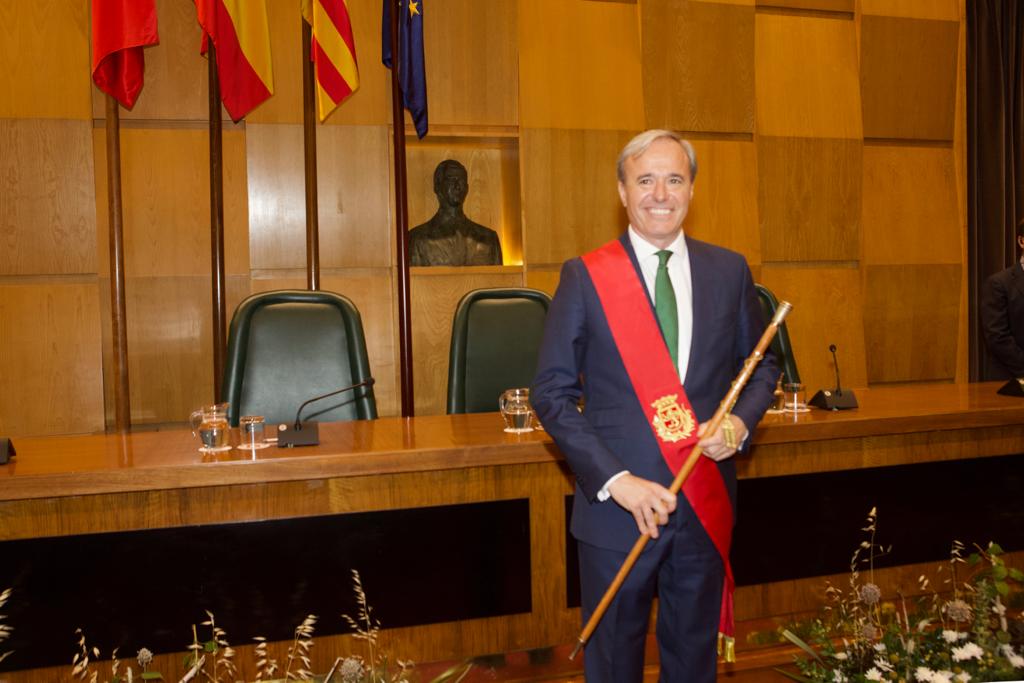
Jorge Antonio Azcón, President of the Autonomous Community of Aragón, whose government approved the appointment at the center of this influence-peddling case.
There are moments when the separation between Church and State ceases to be a legal principle and becomes a fiction sustained by silence. Aragón is living through one of those moments.
While this article is being written, Vicente Jesús López-Brea Urbán is still receiving his salary from the Diocese, despite having effectively abandoned his pastoral responsibilities and despite having secured a senior post within the Aragonese public administration. That fact alone would merit scrutiny. What surrounds it reveals something far more serious.
A Parallel Career Built Under Institutional Protection
For over two years, the Reverend Jesús López-Brea neglected more than fifteen parishes entrusted to him in Jaca. During that same period, he pursued legal studies, carried out internships in Zaragoza—over 140 kilometers away—and actively positioned himself for a civil-service appointment taking a minor public examination. The timeline is not ambiguous. A day has twenty-four hours, not seventy-two.
This parallel life was tolerated by his Bishop Julián Ruiz-Martorell.
The outcome was a direct appointment, outside standard merit-based procedures, to a senior management role in the Aragón health system, taylored for him. López-Brea was placed in charge of roughly 900 staff and ten healthcare facilities, including a regional hospital. His new public salary represents an increase of approximately 450% over his ecclesiastical income—an ecclesiastical income he continued to receive until the very end.
Career civil servants and interim professionals with decades of experience were bypassed.
Media Silence and a Sanitized Public Narrative
Spain’s religious media chose silence. Some outlets avoided confronting episcopal power; others avoided jeopardizing Church advertising revenue. Generalist media largely limited themselves to reproducing partial accounts first published by Heraldo de Aragón, carefully disconnecting López-Brea’s appointment from the broader context in which it occurred.
That context includes a criminal case that Heraldo and others have systematically avoided explaining: the legal action initiated by López-Brea against our team member Jordi Picazo, who exposed—and continues to expose—his conduct through documented investigative reporting and lobbying.
The omission is not accidental. It is structural.
Criminalizing Journalism While Power Advances
Vicente Jesús López-Brea has brought criminal proceedings against Jordi Picazo, seeking prison sentences, heavy fines, and substantial financial compensation. Those proceedings succeeded in imposing a judicial order that effectively silenced reporting on the case for more than two years. During that period of enforced silence, López-Brea consolidated his civil career.
The paradox could not be clearer: journalism was restrained, while power advanced.
It bears repeating that the public prosecutor issued a report finding no criminal conduct in the journalistic work and explicitly underlined its legitimate purpose: to expose institutional double standards within the Spanish Catholic Church. That conclusion, however, did not prevent the chilling effect on freedom of the press.
Political Contradictions at the Top
As public outrage grew, Aragón’s president, Jorge Antonio Azcón, was confronted with the case. According to sources, he expressed personal shock upon learning details of López-Brea’s background—details that had been publicly available for years through investigative reporting.
Yet a second narrative quickly emerged. In a subsequent article, Heraldo de Aragón reported Azcón as having approved the appointment, arguing that the candidate’s “virtues” should outweigh what “people may not like.”
These statements are not contradictory. They are complementary. They reflect a political culture in which reputational management takes precedence over institutional integrity.
The governing Partido Popular thus stands accused of facilitating an appointment that launders a deeply problematic past through state authority.
Legal Contradictions and Ecclesiastical Silence
The law firm Cremades & Calvo-Sotelo took López-Brea’s defense. This is the same firm commissioned by the Spanish Episcopal Conference to audit clerical sexual abuse.
The law firm Cremades & Calvo-Sotelo considered itself able to simultaneously sustain two converging positions within the same institutional framework. On the one hand, it has participated in public and semi-public narratives that frame clerical sexual abuse as being largely linked to homosexuality—a line of argument situated within the same ideological and doctrinal orbit that led the Spanish Episcopal Conference to commission the firm’s audit on clerical sexual abuse of minors under particularly favorable financial conditions, reportedly amounting to €1.2 million. On the other hand, the firm undertook the legal defense of Vicente Jesús López-Brea Urbán, a priest whose documented conduct stands in open contradiction with Catholic moral teaching. The coexistence of both positions within the same institutional ecosystem exposes a deeper structural incoherence, where reputational management and institutional convenience take precedence over moral clarity and accountability.
At the ecclesiastical level, serious questions remain unanswered regarding the validity of López-Brea’s ordination under canon law, facilitated by the former bishop of Huesca-Jaca. Church authorities have chosen silence.
The Opposition Breaks the Wall of Silence
The left-wing opposition party Chunta Aragonesista has publicly committed to acting on the influence-trafficking network exposed by this investigation. Their intervention marks a shift: what was once dismissed as an uncomfortable Church matter is now clearly a political scandal.
A Case That Defines a System
This is not an isolated episode. It is a case study in how power circulates when institutions protect one another: the Church shielding clergy, the judiciary constraining journalism, media diluting facts, and political authorities benefiting from opacity.
What is at stake is not only the credibility of the Catholic Church at large or the integrity of Aragón’s public administration, but fundamental democratic principles: freedom of information, equality of access to public office, and the real—not rhetorical—separation between Church and State.
Nothing hidden remains hidden forever. In Aragón, the architecture of silence has cracked. Whether accountability follows is no longer a theological question. It is a political one.
All rights reserved, @jacquespintor 2026. For contact, you may want to write to us at jacquespintor@gmail.com. Find us in twitter @jacquesplease.