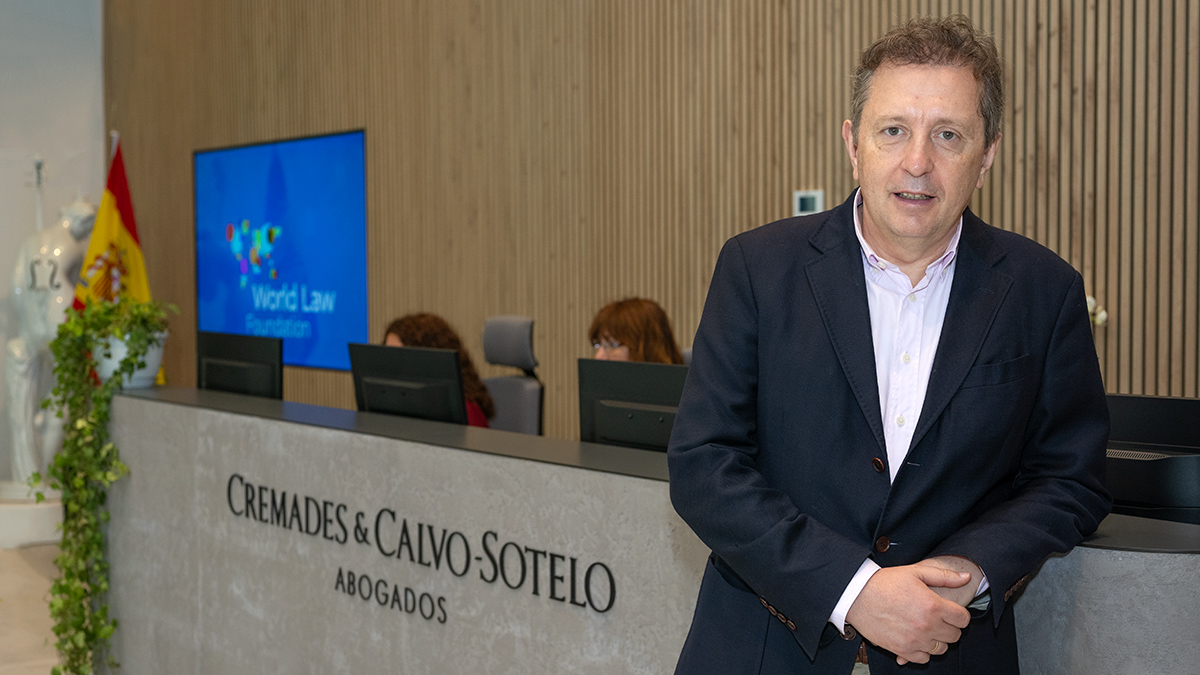
Javier Cremades, President of the World Jurist Association and head of the law firm Cremades & Calvo-Sotelo, photographed at his office premises in Madrid.
After the questions and the contrast between rhetoric and reality, we now address the core problem: how judicial persecution is activated, deployed, and sustained against an investigative journalist when their work challenges powerful institutions. This part does not theorize — it examines the actual mechanics.
In the first two installments, the questions were raised and the contrast was established. In this third part, we focus on the how: how judicial persecution of an investigative journalist is triggered, carried out, and maintained over time. This is not about abstract principles, but about concrete mechanics.
How to follow this series
This investigation is published as an open, ongoing series, in which each installment adds a new layer of analysis on the use of the law as a tool of pressure against investigative journalism. The installments published so far are:
1. Press freedom under judicial pressure: eight public questions on the role of Javier Cremades and the Pajares law firm
An initial public challenge. Seven documented questions that do not accuse, but compel readers to take a position on coherence, proportionality, and the real impact of legal actions brought against a journalist.
👉 https://corruptspanish.church/press-freedom-under-judicial-pressure-eight-public-questions-on-the-role-of-javier-cremades-and-the-pajares-law-firm/
2. Javier Cremades, a necessary cooperator in a criminal scheme against investigative journalism
A direct contrast between institutional rhetoric about the rule of law and the legal practices deployed against a journalist investigating abuse and corruption. This installment exposes the breach between words and actions.
👉 https://corruptspanish.church/cremades-calvo-sotelo-a-necessary-cooperator-in-a-criminal-scheme-attack-on-press-freedom-2/
3. Javier Cremades and the mechanics of judicial persecution against investigative journalism
A detailed analysis of the how: criminal complaints, economic pressure, personal measures, and calculated attrition. Not a theory, but a recognizable mechanism with real deterrent effects. This entry.
New installments will be added to this index as the investigation progresses.
1. The Entry Point: Criminalizing Investigation
The first strategic move is not to respond to the information published, but to shift the conflict from informational terrain into the criminal arena. A criminal complaint — even if it ultimately does not prosper — serves an immediate function: it inverts roles. The journalist ceases to be the one asking questions and becomes the one on the defensive. Time, resources, and attention are diverted from the subject under investigation to the journalist themselves.
This shift is crucial: it reframes a public debate as a personal problem and creates a context of suspicion that operates even without conviction. The implicit message is not legal — it is cultural: investigating carries a cost.
2. Economic Pressure as a Central Lever
In addition to the criminal route, there is an economic strategy with significant impact: disproportionate claims, requests for seizures, deposits, and financial demands that no independent journalist can sustain without risking their livelihood. It is not necessary to win the lawsuit to achieve the objective. Prolonging it suffices.
Here, the law functions as a wear-and-tear device. Every filing, every appeal, every procedural step carries a material and psychological cost. The effect is not measured in rulings, but in exhaustion.
3. Personal Measures and Deterrent Impact
When, on top of that, personal measures are applied — such as limitations on movement — the message becomes unmistakable: the pressure is not directed solely at the published work, but at the life of the journalist. The goal is to generate an ongoing environment of insecurity that encourages silence, self-censorship, or withdrawal.
These types of measures do not only affect the individual. They operate as warnings to the broader journalistic community.
4. The SLAPP Pattern and Its Real Logic
This set of practices fits what is internationally recognized as SLAPP (Strategic Lawsuits Against Public Participation): strategic legal actions intended to deter public participation. What defines them is not the legal strength of the case, but the deterrent effect.
The pattern repeats itself:
- The criminal route is activated.
- Economic pressure is amplified.
- Legal timelines are prolonged.
- The cost is personalized.
The result is not justice — it is silencing.
5. Contrast With the Rhetoric of the Rule of Law
This mechanism takes on special significance when viewed in light of the public discourse promoted by Javier Cremades as president of the World Jurist Association. While the rule of law is proclaimed as a guarantee of freedom, a response is tolerated — or even propelled — in which the law is used in ways that discourage effective exercise of that freedom when it affects certain entrenched interests.
This is not a rhetorical contradiction. It is a practical breach between what is said and what is done.
6. Democratic Impact
When investigative journalism faces this type of response, what is at stake is not an individual reputation but society’s right to know. Judicial persecution of the reporter impoverishes public debate, weakens democratic checks and balances, and protects, by omission, what should be subject to scrutiny.
The final question is not whether the journalist will endure. It is what remains of democracy when investigation becomes a high-risk activity.
Yanelis Tovar. Editor
Readers are invited to comment, contribute information, and take part in a factual and respectful debate.
If you believe that any statement of fact contained in this article is inaccurate, you may contact the editorial team in order to exercise your right of reply or to request a factual clarification or correction, in accordance with journalistic standards.

The editorial team is also available for interviews; this applies — under appropriate protective safeguards — also to some of the individuals affected.

© Jacques Pintor, 2026. All rights reserved. Any reproduction or redistribution without prior authorization is prohibited. Contact: jacquespintor@gmail.com X: @jacquesplease

#InvestigativeJournalism #RuleOfLaw #PressFreedom #SLAPP #PublicInterest #CremadesCalvoSotelo
#InstitutionalTransparency #PressFreedom #RuleOfLaw #InvestigativeJournalism #FreedomOfExpression #PublicInterest