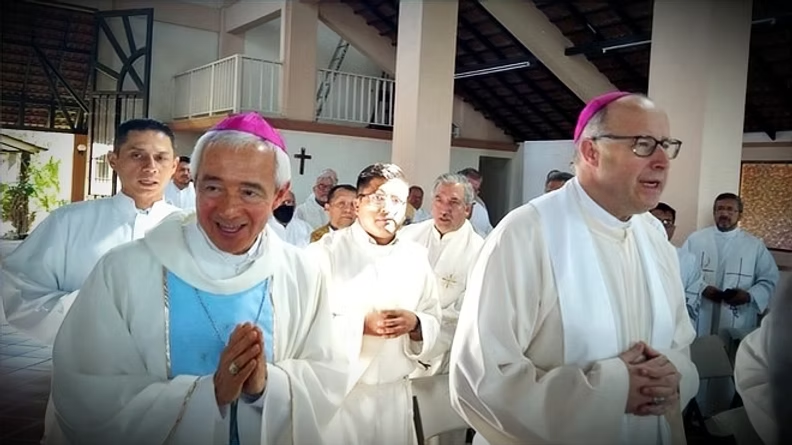
Monseñor Patrón Wong obispo de Xalapa en México, y monseñor satué a la derecha de la foto. Satué dirigió unos ejercicios espirituales invitado por Patrón Wong en Xalapa. Isaí Zarza estuvo unos meses de prácticas en ese entorno antes de su ordenación diaconal de finales de 2025.
Isaí Zarza remained, until the day of his ordination as a deacon on Sunday, September 7, 2025, a seminarian originally from Calatayud (Aragon in Spain), taken in by the Diocese of Teruel-Albarracín—the same diocese shepherded by Bishop José Antonio Satué until his recent transfer to the Diocese of Málaga.
[IN THE PICTURE: Monsignor Patrón Wong, Bishop of Xalapa (Mexico), and Bishop José Antonio Satué, on the right-hand side of the photograph. Satué led a series of spiritual exercises at the invitation of Patrón Wong in Xalapa. Isaí Zarza spent several months on pastoral placement in this same environment prior to his diaconal ordination in late 2025.]
Isaí Zarza
From the outset, Isaí Zarza’s trajectory has been marked by episodes of gravely improper conduct. During his initial period as a student at the Metropolitan Seminary of Zaragoza, he was reportedly caught engaging in sexual acts with another seminarian inside seminary facilities, according to members of the Christian community itself. This incident led to his expulsion.
During the period following his removal from the seminary, Zarza was taken in by Rev. Miguel Ángel Estella, who minimized the incident as “youthful behavior” and offered him accommodation at his Sacred Heart parish in Zaragoza. There, Zarza entered into a close relationship with the then-young seminarian Vicente Jesús López-Brea, a relationship that evolved into a romantic involvement and sexual encounters, including within parish premises, until little before López-Brea’s priestly ordination (whenLópez-B entered the Metropolitan Seminary of Zaragoza though, he had another sexual partner).
This background did not prevent Zarza from being readmitted to the same seminary after a change in leadership. The new rector, the Reverend Javier Pérez Mas—also head of the Office for the Reception of Complaints and for the Prevention of Abuse for the Aragonese dioceses—authorized his return, not as a seminarian of Zaragoza, but under the sponsorship of the Diocese of Teruel, which lacked vocations. Thus, what Zaragoza had rejected was accepted by Teruel, in what has been interpreted as a “vocational rescue” driven more by statistical needs than by any serious discernment of suitability.
On September 8, 2024, the Bishop of Teruel-Albarracín, José Antonio Satué, presided over the ceremony in which Isaí Zarza was instituted as lector and acolyte—the final step prior to the diaconate—at the parish of Saint Emerenciana in Teruel. Numerous diocesan priests attended the Mass alongside Bishop Satué, including the rector of the Seminary of Zaragoza, Javier Pérez Mas (since Teruel seminarians pursue their studies at the Zaragoza seminary, which hosts candidates from all Aragonese dioceses), as well as Zarza’s fellow seminarians. The presence and participation underscored the importance and institutional support the diocese extended to this candidate.
In his homily, Satué addressed Zarza affectionately—“dear Isaí”—urging him to “open himself to truth, to his brothers, to God” at this decisive stage.
The Isaí Zarza case reveals a deeply perverse dynamic: seminarians with documented histories of sexually active and immoral conduct, supported by figures such as Estella, Pérez Mas, and Bishop Satué himself, advance toward priesthood, while seminarians identified with more conservative profiles—faithful to liturgy and prayer—are removed under ideological pretexts. Zarza’s diaconal ordination on September 7, 2025, presided over by Bishop Satué, thus represents the culmination of a chain of favors and cover-ups that undermines the moral integrity of the Church and exposes minors and the broader Christian community to serious risk.
During those same days back in September 2024, Satué’s attention was largely consumed by the pseudo-trial of the Gaztelueta Case, whose ruling he signed three months later, on December 17 of that year. Even so, the ruling was never formally communicated to the parties and was instead leaked by a progressive internet outlet aligned with the Spanish Episcopal Conference on March 3, 2024.
Isaí Zarza and his former partner, Rev. Vicente López-Brea Urbán
Rev. Vicente Jesús López-Brea Urbán has long been a controversial figure in Aragon: a priest whose personal scandals and meteoric rise to a senior position within Spain’s civil service have drawn scrutiny, to the point of raising suspicions of high-level political and ecclesiastical influence-peddling. Isaí Zarza reportedly maintained an intimate relationship with López-Brea until the latter’s priestly ordination; for a time they were “boyfriends,” engaging in sexual relations until shortly before López-Brea entered the seminary.
López-Brea abandoned active priestly ministry some time before entering public service, preparing that transition under the protection and support of his father—a high-ranking military officer and executive at the Fundaz foundation—and his own bishop.
Jesús Roy
Jesús Roy is a young Aragonese man born in 1997, originally from the town of Aniñón (province of Zaragoza). He gained media notoriety in April 2024 when, as a seminarian of El Burgo de Osma (Diocese of Osma-Soria, Castile), he sang an Aragonese jota to Pope Francis during a Vatican audience. The scene, widely circulated by regional media and on social networks, showed a visibly pleased Pope shaking Roy’s hand and praising the gesture. Roy was soon dubbed “the Aragonese seminarian who sang a jota to the Pope,” a source of pride for his hometown and for the Aragonese Church.
Behind that idyllic image, however, lies controversy. Our journalistic investigations reveal that Roy had not been admitted to the Seminary of Tarazona (a neighboring Aragonese diocese) due to sexual scandals involving swing clubs. According to available information, Roy engaged in improper conduct in his local environment, leading Bishop Vicente Rebollo of Tarazona to reject his admission. Despite these negative reports, Roy succeeded in being accepted by another bishop, entering the Seminary of Osma-Soria—in other words, he changed dioceses to continue his vocational path, bypassing the initial obstacle.
In Osma-Soria, Roy found a more favorable environment and integrated with seminarians from Burgos (where Osma sends its candidates for formation). It was with this group that he traveled to Rome and performed his widely applauded musical display before the Pope.
Most strikingly, Jesús Roy and Isaí Zarza are alleged to have collaborated in improper acts of telephone harassment against third parties. According to the body of our investigation—which includes recorded witness testimony—a complaint has been filed, to which we have obtained exclusive access, against Roy and Zarza before the courts of Alicante for alleged telephone harassment and stalking.
Details of these events were reportedly communicated to Rev. Javier Pérez Mas (in his capacity as rector of the Metropolitan Seminary of Zaragoza and director of the unusual abuse-complaint office he himself heads) by an elderly priest from Tarazona, a friend of Roy’s, who lent Roy his computer during regular visits to his home. There may be an age difference of roughly thirty years between them, making the nature of their relationship relevant to inquire about. This priest, José Carlos, reportedly brought videos and photographs—obtained from his own computer and published on Roy’s social networks—to Pérez Mas. José Carlos himself confirmed this in conversations recorded by witnesses.
The Alicante complaint identifies as victim a third seminarian, removed from the Zaragoza seminary by Pérez Mas on the pretext that he “prayed too much” or would be a priest with “too little smell of sheep.” Paradoxically, Pérez Mas nevertheless approved Zarza’s progression toward diaconal ordination despite possessing evidence of this candidate’s grave unfitness.
The cases of Isaí Zarza and Jesús Roy illustrate a recurring pattern: seminarians whose paths are marked by improper conduct are sustained and promoted, while those more devout and faithful to ecclesial tradition are sidelined, as we mentioned above. This dynamic exposes a formation system tainted by ideological favoritism and a clerical protection network that prioritizes internal loyalties over moral and pastoral integrity.
These unusual movements of seminarians raise pressing questions: How and why did Isaí Zarza shift from the Archdiocese of Zaragoza to become a seminarian for Teruel? According to cited sources, support may have come both from Bishop José Antonio Satué—needing seminarians for his diocese—and from the Archbishop of Zaragoza, Carlos Escribano, who reportedly gave his approval for Zarza to resume studies at the regional seminary, now under the Diocese of Teruel-Albarracín.
Notable Transfers of Bishops
Observers noted the transfer of Bishop Satué from Teruel-Albarracín to Málaga, as well as the move of the Bishop of Osma-Soria, Abilio Martínez Varea, to Ciudad Real, where he took office on September 27, 2025.
These followed the transfer of Bishop Julián Ruiz Martorell—prelate of Vicente López-Brea—to the Diocese of Guadalajara, and that of the former rector of the Seminary of Zaragoza, Mgr. Fernando Arregui. While rector, Arregui had formally warned Bishop Julián Ruiz Martorell that López-Brea could not and should not be ordained due to his publicly known dissolute life. Both bishops were later summoned as witnesses in proceedings initiated against me by the Catholic law firm Cremades & Calvo-Sotelo (linked to Opus Dei), which had already received a multimillion-euro mandate from the Spanish Episcopal Conference to audit the case of sexual abuse by clerics in Spain
Fernando Arregui was subsequently sent to work at the Vatican under the patronage of Cardinal Omella, who had previously sponsored Satué’s appointment to the same Dicastery—of which Omella himself is also a member. Arregui arrived at the Dicastery for Bishops as an official in December 2023. Robert Prevost had been appointed prefect of the Dicastery that same January by Pope Francis and was later elected Pope Leo XIV in 2025, following the Pope’s death under circumstances that remain unclear.
The Zarza, Roy, and López-Brea cases—among others (including Enrique Ester, Gonzalo Ruipérez, Canon Ruiz, sexting scandals among priests in Zaragoza, etc.)—have been exposed exclusively through our investigation. This is less a source of pride than evidence of the media’s fear of lawsuits whenever homosexual conduct is at the center of an ecclesiastical scandal.
The author of this post—dear reader—the sole member of the Jacques Pintor team in Spain, lives in exile due to persecution and accusations of psychological torture and homophobia (not slander or defamation, a crucial distinction) brought by sexually dissolute priests defended by catholic, Opus Dei affiliated Cremades & Calvo-Sotelo law firm. Prosecutors seek over four years of imprisonment and nearly half a million euros in fines; initially, 100% of my assets were frozen through illegal legal tactics. This illustrates the clericalism of Spanish justice, unwilling to apply criminal law for fear of receiving a call from a cardinal and jeopardizing a judge’s career. At one point, both the President of the Supreme Court and the President of the Constitutional Court were members of Opus Dei. While this should mean nothing, we do not live in Thomas More’s Utopia. We will not cry “Freedom or Death.” We ask only for Justice. Fiat iustitia, ruat caelum. Pax et Bonum.
Institutional Consequences for the Church
By permitting these ordination—invalid in substance and form—and by transferring bishops implicated in cover-ups to new sees or even to the Vatican itself, the Spanish Church demonstrates a desire to conceal without correction. The promotions of Zarza and Roy are the tip of an iceberg threatening the future of the Christian community: instead of healing wounds, networks are consolidated that launder immoral trajectories and discredit the holiness of ministry before believers and public opinion alike. Pastoral credibility will not be restored through transfers or institutional statements, but through a radical purification that, judging by the facts, has yet to occur. In Spain, ordinations thus become gestures of structural obedience rather than fruits of genuine spiritual discernment.
Silence surrounding reports of Zarza’s stay in Mexico during his pre-diaconal pastoral placement constitutes, alongside this clerical protection network, a deliberate concealment of truth from the faithful. The decree prior to his ordination states that the candidate completed “pastoral experiences, especially during his stay in Mexico,” without specifying where or under whose auspices. This vagueness is not accidental. It was in Mexico that Satué and Germán Arana preached clergy retreats in 2022, invited by Archbishop Patrón Wong (in the featured image, with Satué at the right side of the picture), who later—partially misled—received Zarza. This reinforces the hypothesis that Zarza’s passage through the Americas formed part of a strategy of “reassignment and symbolic purification” before reintegrating him into the formation itinerary. Satué, as pontifical delegate and commissioner of the Institute of the Incarnate Word, knows that appearances matter above all.
Jordi Picazo
Readers are invited to comment, contribute information, and engage in reasoned debate. If you believe any factual statement in this article is inaccurate, you may contact the editorial team to exercise your right of reply or request factual clarification or correction, in accordance with journalistic standards.
The editorial team is also available for interviews, as are some of the victims, where appropriate and with due safeguards.
To access source links and additional documentation, readers may wish to consult the Spanish version of this post on this site. If you consider this investigation relevant, please share it.

#InvestigativeJournalism #CatholicChurch #SeminaryScandal #EpiscopalAccountability #FreedomOfThePress #ChurchReform #Spain #HomosexualClergy

© Jacques Pintor, 2026. All rights reserved. Reproduction or redistribution without prior permission is prohibited.
Contact: jacquespintor@gmail.com