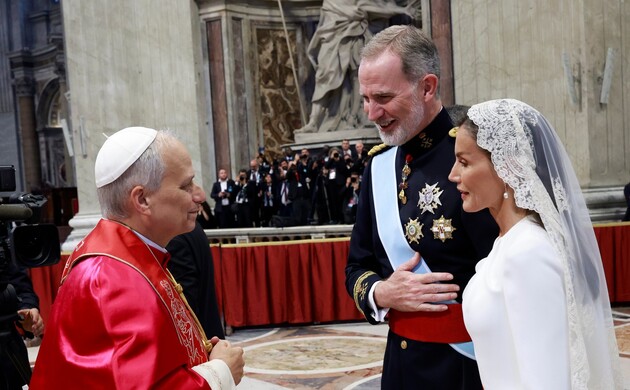
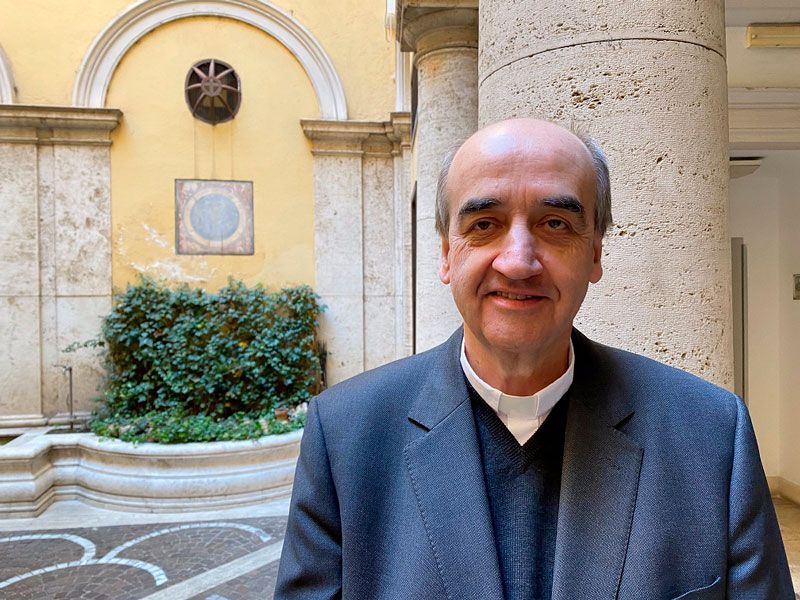
Pope Francis has appointed Fr. Pedro Aguado Cuesta, Sch.P., back then Superior General of the Order of the Pious Schools (Piarists), as Bishop of the Diocese of Huesca-Jaca. The appointment was made public at 12:00 noon, Saturday, 29 March, as communicated by the Apostolic Nunciature to the Spanish Episcopal Conference.
“The essence of journalism is dramatic. The real journalist hides the self and reveals others; gathers scattered vibrations and transmits them; like the actor, disappears beneath the reality being conveyed.”
— Rafael Barrett
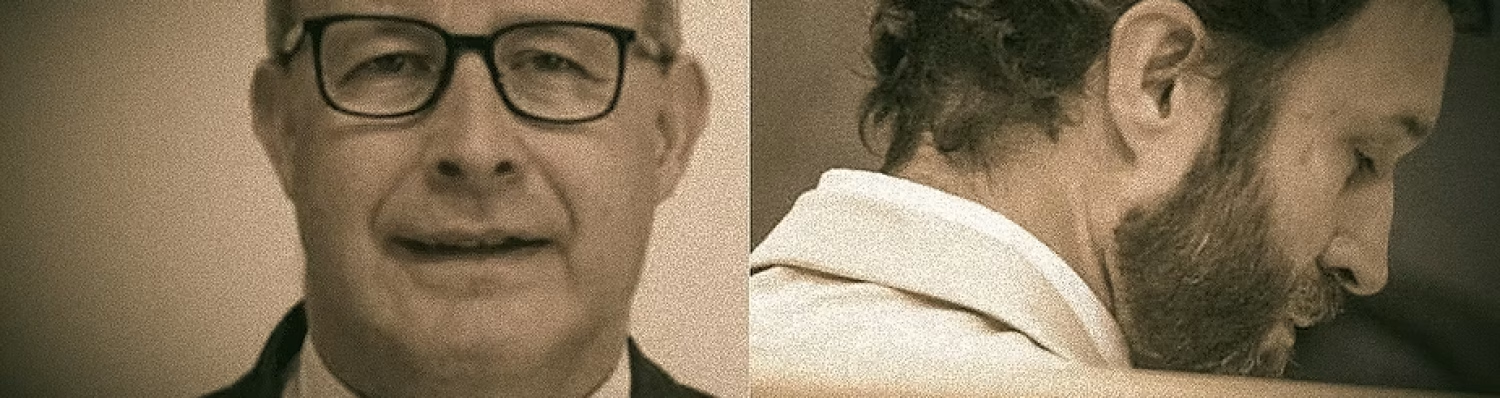
Pedro Aguado Cuesta, former Superior General of the Piarist Fathers and current Bishop of Huesca-Jaca (Spain), is named in an investigation that connects Mexico, Aragón, and Rome, following the public testimony of Javier Alcántara, a survivor of abuse attributed to the Piarist priest Miguel Flores Martínez.
The case centers on what the survivor describes as a pattern of deception, institutional silence, and broken promises, allegedly carried out while Aguado held the highest authority within the Escuelas Pías.
According to Alcántara, after publicly denouncing what he considers falsehoods and omissions by Bishop Aguado and by the Piarist Order, he received death threats. These threats, he states, followed his refusal to remain silent and his decision to make public a series of communications and commitments that, in his view, were never honored.
At the center of the controversy is a document written in Latin, presented to the survivor as a formal response and as a sign of institutional seriousness. Alcántara maintains that the document, rather than resolving the matter, became part of a strategy to delay, neutralize, and ultimately suppress his claims. What was initially framed as a path toward truth and accountability, he says, turned into a mechanism of control.
The survivor’s testimony places special emphasis on Pedro Aguado’s personal role at key moments:
– promises of action that were not fulfilled,
– assurances that did not materialize into concrete measures, and
– an institutional posture that, according to Alcántara, prioritized the protection of the Order over the protection of victims.
This investigation also traces how a case that originated in Mexico eventually reached Spain, coinciding with Aguado’s transition from religious superior to diocesan bishop. The move, Alcántara argues, did not close the matter but rather exported an unresolved scandal, now embedded within a Spanish diocese.
The Escuelas Pías have historically presented themselves as an order devoted to education and the protection of minors. It is precisely this reputation, Alcántara insists, that makes the alleged cover-up especially serious. In his account, institutional prestige functioned as a shield, discouraging scrutiny and isolating the survivor.
This article does not issue judicial conclusions. It reports, documents, and contextualizes a public denunciation made by a survivor who claims to have been pressured, deceived, and threatened after speaking out. The facts described here are based on his testimony and on the documentation he has made available.
As this investigation develops, further information will be published.
This article was first published on November 19, 2025.
By Yanelis Tovar